


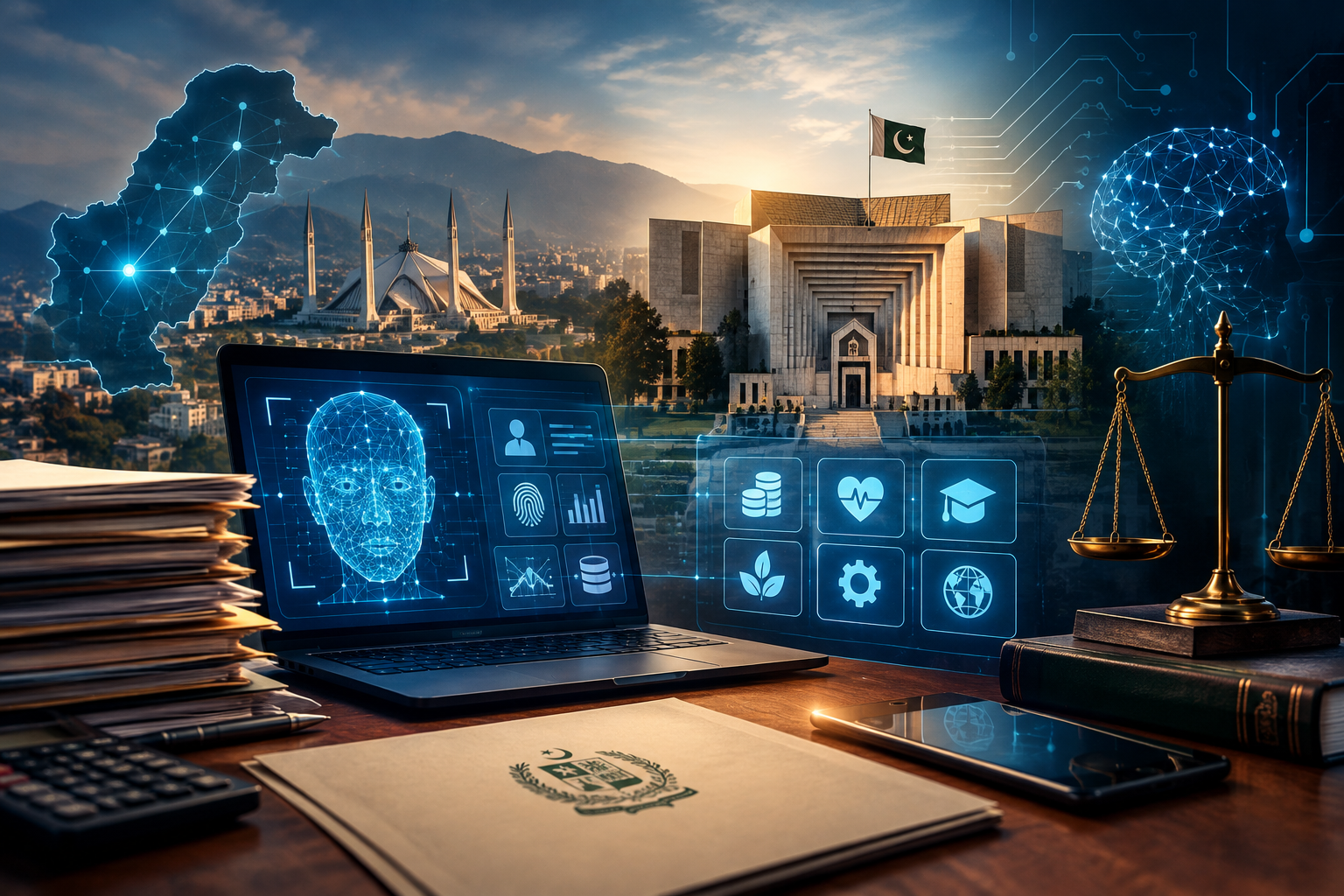
A government office in Islamabad can now use technology to monitor projects, analyse data and support decisions across ministries. Pakistan’s Federal Board of Revenue is considering AI-based tools for tax enforcement. The country’s courts have issued national guidelines for using artificial intelligence in judicial institutions. And in 2025, the federal government approved its first National Artificial Intelligence Policy, setting out plans to expand AI across the economy and public services.
The government presents this transformation as a way to make public administration faster, more efficient and more transparent. But as artificial intelligence moves from laboratories and technology companies into government offices, another question is becoming harder to avoid, when an algorithm helps make a decision about a citizen, who is responsible when the decision is wrong?
Pakistan is not alone in facing this question. India has built one of the world’s largest digital identity systems around Aadhaar and is expanding the use of AI-based facial authentication. Bangladesh is developing a national AI framework that includes plans for AI-assisted government decision-making. Across South Asia, governments are moving toward systems that can identify people, assess information, detect possible fraud, target public services and support decisions that can affect people’s lives.
The technology may be new, but the problem is an old one. Governments have always made decisions that determine whether someone receives a benefit, pays a tax, gets access to a service or faces investigation. What changes with automated systems is that the reasoning behind a decision can become harder for an ordinary citizen to see or challenge.
Pakistan approved its National Artificial Intelligence Policy in July 2025. The policy calls for responsible and ethical AI use and says the country needs safeguards for fairness, transparency, accountability, data protection, privacy and human rights. It also envisages AI applications across sectors including education, health, agriculture, climate, business and governance.
The government’s language is deliberately reassuring. The policy says AI should be adopted responsibly and with the interests of ordinary citizens in mind. In February 2026, the Pakistan Digital Authority said the country’s approach would be based on “human accountability” and responsible AI governance. The authority described itself as the country’s apex body for digital governance, data and AI regulation.
But policy promises are different from what happens when a system is actually used. Consider taxation. In May 2026, Pakistan’s government said it was considering AI-based tax enforcement reforms as part of efforts to reduce the country’s tax gap. Officials reviewed technology-driven measures aimed at tackling under-reporting, non-reporting, under-invoicing, tax evasion and smuggling.
For the state, the attraction is obvious. Pakistan has millions of taxpayers and businesses and a tax system that officials have long struggled to monitor. Software can process information at a scale that individual tax officers cannot. A system can compare records, identify unusual transactions and flag people or businesses for further investigation.
But a flag is not the same thing as proof. An unusual transaction may be legitimate. A person’s financial circumstances may have changed. Data held by one government department may be incomplete or outdated. A computer system can identify a pattern without understanding why that pattern exists.
That distinction becomes important when an automated assessment leads to a real consequence for a person. If a tax authority asks someone to explain a transaction, the individual may still be able to respond. But if the underlying system is difficult to understand, the citizen may not know why they were selected in the first place. The question then becomes whether a person has a meaningful opportunity to challenge the decision or is simply expected to prove that the machine was wrong.
Pakistan’s government is also building AI into the machinery of governance itself. In June 2026, the Economic Affairs Division reported that the Prime Minister’s Office was reviewing an AI-powered platform designed to connect federal ministries with the Prime Minister’s Office and provide real-time monitoring of government initiatives. Officials described the system as a tool for improving coordination and monitoring.
This is not necessarily a problem. Governments have legitimate reasons to use software to process large amounts of information and improve administration. The important question is what happens when such systems move from helping officials understand information to influencing decisions that affect individual rights and access to public services.
That distinction is already becoming part of Pakistan’s own regulatory debate. A draft National Data Governance Policy published in 2026 proposed that people affected by automated systems making decisions with legal or similarly significant effects should have a right to meaningful human review. The policy also proposed privacy protections and limits on the amount of data government agencies share with each other.
That principle could become one of the most important safeguards in the country’s digital transformation, a person should not have to argue with an algorithm without being able to reach a human decision-maker.
Pakistan’s judiciary is confronting the same issue. In April 2026, the National Judicial Policy Making Committee issued national guidelines for AI in judicial institutions. The guidelines say AI should assist rather than replace judicial decision-making and emphasise human judgment, constitutional safeguards, transparency, accountability and data protection.
The language is significant because courts represent one of the areas where automated systems could have particularly serious consequences. An AI tool might help a judge search legal documents, organise case files or manage a large caseload. But a system that effectively determines how a person should be treated by the justice system raises a much more difficult question.
Who takes responsibility? India provides a useful comparison because it has already operated digital systems at a scale that Pakistan is only beginning to contemplate.
Aadhaar, India’s national biometric identity system, has approximately 1.34 billion live holders, according to the Indian government. By March 2026, it had processed more than 17,000 crore authentication transactions. The government says more than 3,100 Direct Benefit Transfer schemes and over 360 public services use Aadhaar-based authentication or verification.
The Indian government argues that the system helps deliver welfare more efficiently and prevent duplication and fraud. It says Aadhaar authentication can help ensure that benefits reach the intended recipient.
The technology has also moved beyond fingerprints and iris scans. India’s Unique Identification Authority says its AI and machine-learning-based facial authentication system recorded more than 130.5 crore transactions by the end of March 2025, including nearly 102 crore during the 2024-25 financial year.
The government’s position is that these tools make authentication easier and more secure. But the experience of digital welfare delivery shows why technical efficiency does not automatically mean social fairness.
An analysis by India’s Centre for Financial Accountability documented forms of digital exclusion linked to welfare systems, including Aadhaar mismatches, biometric authentication failures, incorrect bank linkages and problems with the National Payments Corporation of India mapper. It argued that such technical barriers can disproportionately affect poor people, older people and people with disabilities.
Indian parliamentary research has also noted authentication problems in the public distribution system. A PRS analysis cited UIDAI data showing authentication failure rates of 8.5% for iris scans and 6% for fingerprints across all purposes, while noting that field studies have found cases where biometric problems delayed access to food entitlements.
The Indian government, however, says welfare should not be denied because of Aadhaar authentication failure and that alternative methods are available. In March 2026, the government said it had introduced multiple authentication methods, including biometrics, one-time passwords and facial authentication, to reduce such problems.
The disagreement illustrates the central issue with automated government. A government can measure how many transactions a system successfully completes. A citizen experiences something different: whether they received their pension, food or healthcare when they needed it.
The system may be working statistically while failing an individual.
That gap between the aggregate performance of a system and the experience of a person is one of the most important issues for governments adopting AI.
Bangladesh is now preparing to confront the same question. The country released a second draft of its National Artificial Intelligence Policy 2026-2030 in February 2026. The draft places strong emphasis on responsible and inclusive AI governance. It proposes safeguards for high-risk AI systems, including algorithmic impact assessments, and says government decision-making assisted by AI should preserve human responsibility.
The proposed Bangladeshi framework goes further by identifying social welfare eligibility as a potential use for AI decision-support systems. Under the draft approach, an AI system could analyse information such as household composition, income, assets and vulnerability indicators and provide an eligibility recommendation, but a human official would still have to review and approve the final decision.
That model raises an important distinction. There is a difference between AI deciding and AI assisting a decision.
If a computer recommends that a family qualifies for a welfare programme and a government official independently checks the evidence, the human retains responsibility. If the official simply accepts the machine’s recommendation because it appears objective or technically sophisticated, the distinction becomes largely theoretical.
This is sometimes called automation bias: the tendency of people to place too much trust in a computer-generated recommendation. The problem becomes greater when citizens cannot see the information or assumptions behind the recommendation.
Imagine a welfare applicant whose benefits are rejected because an automated system determines that their household income is above the eligibility threshold. The person’s records may contain an error. A family member may have moved away. A government database may contain old information. The algorithm may have been trained on data that does not accurately represent the person’s circumstances.
If the citizen can speak to a human official who explains the decision and checks the evidence, the error can potentially be corrected. If the response is simply that “the system says you are not eligible,” accountability has effectively disappeared.
The same principle applies to policing. India has been expanding the use of technology in policing, forensics, prisons and courts. In February 2025, India’s Ministry of Law and Justice said artificial intelligence was helping integrate these areas and described the goal as creating a more efficient justice system. Prime Minister Narendra Modi was quoted as saying, “Technology will integrate police, forensics, jails, and courts, and will speed up their work as well.”
Technology can certainly help police process information. But police systems can also affect who is investigated, monitored or treated as suspicious. Facial recognition provides a clear example.
India’s NITI Aayog has previously recommended transparency in procurement of facial-recognition technology, including disclosure of vendors’ responsibilities for effectiveness, errors and bias. It also recommended that governments conduct impact assessments and disclose error rates across different demographic groups.
Those recommendations point to another accountability problem, the government may not have built the system itself.
An algorithm used by a government agency may have been designed by a private company. The company may consider aspects of the system proprietary. The government may have signed a contract that limits public access to technical information. Citizens affected by the system may therefore be unable to determine how it reached its conclusion.
This creates a chain of responsibility with several links: the government that purchased the system, the agency that deployed it, the official who relied on its recommendation and the company that built it.
When something goes wrong, responsibility can move from one link to another. The issue is becoming more important as governments across South Asia move quickly to build national AI systems.
Bangladesh has been training civil servants and procurement officials in responsible AI governance. In June 2026, UNESCO and the Bangladeshi government launched a programme designed to help public officials understand AI systems, ethical safeguards and responsible procurement.
Pakistan has created a Pakistan Digital Authority to oversee digital governance and AI regulation. Bangladesh is developing a national AI policy. India has already deployed AI and biometric technologies at enormous scale.
The three countries are at different stages, but they are moving in the same direction. Government is becoming more dependent on data.
And once governments have large amounts of data, AI makes it possible to analyse that information in ways that were previously too expensive or too slow. This can bring real benefits. A system could identify a person who is eligible for a social programme but has never applied. It could detect tax fraud that human officials would miss. It could help a hospital predict demand. It could identify delays in public projects. It could help courts search thousands of documents.
The problem is not that governments are using technology. The problem is what happens when efficiency becomes more important than explanation.
A government employee can make a mistake and potentially explain it. A machine-learning system can make thousands of decisions using a pattern that is difficult even for its developers to explain.
That is why transparency cannot simply mean publishing a government AI policy. It has to mean telling citizens when an automated system is being used, what role it plays, what information it relies on and how a person can challenge its outcome.
There is also a question of procurement. Governments routinely buy software from private companies, but AI systems are different from ordinary IT infrastructure because they can influence decisions. Procurement documents should therefore answer questions that are often left to technical specialists: What is the system designed to do? What data was used to test it? How accurate is it? Does its performance vary across regions, languages, genders or socioeconomic groups? Who audits it? Who owns the data? What happens when the contract ends?
These questions matter particularly in countries where government databases contain information about millions of people.
Pakistan’s National Registration and Biometric Policy Framework, notified by the federal cabinet in January 2025, is intended to create an integrated national registration and biometric ecosystem. NADRA describes itself as the national authority responsible for citizen registration and the country’s central identity database.
The combination of identity data, welfare information, tax records, health data and other government databases could give states unprecedented capacity to understand their citizens. Used carefully, that could make government services more efficient.
Used without sufficient safeguards, it could also create new forms of exclusion or surveillance. The question is therefore not whether South Asian governments should use AI.
They almost certainly will. The more important question is whether democratic institutions can build rules quickly enough to keep humans accountable for the systems they deploy.
The answer may depend on a few basic principles.
Citizens should know when AI is materially involved in a government decision about them. They should be able to obtain meaningful human review when an automated decision has significant consequences. Government agencies should be able to explain the purpose of the system and identify the organisation responsible for it. High-risk systems should be independently tested for accuracy, discrimination and security before they are widely deployed. Procurement contracts should contain clear requirements for auditing, data protection and responsibility for errors. And governments should maintain records that allow an automated decision to be investigated after something goes wrong.
None of these safeguards requires governments to abandon technology. They require governments to accept that technology does not remove responsibility.
For South Asia, this is becoming an urgent issue. Pakistan’s AI policy promises responsible use. India is expanding AI-based identity authentication and digital public services. Bangladesh is developing a framework that could allow AI to support decisions about welfare and other government functions.
The region is therefore becoming a laboratory for a new kind of government: one in which databases, algorithms and automated systems increasingly sit between citizens and the state.
The success of that transformation should not be measured only by how quickly a government processes an application or how many transactions a system completes.
It should also be measured by what happens to the person whose application is rejected, whose identity cannot be verified, whose tax account is flagged or whose data is used to make a decision they do not understand.
An algorithm can process millions of cases in seconds. But when one of those cases belongs to you, the most important question remains remarkably human:
Who will listen when the machine gets it wrong?
