


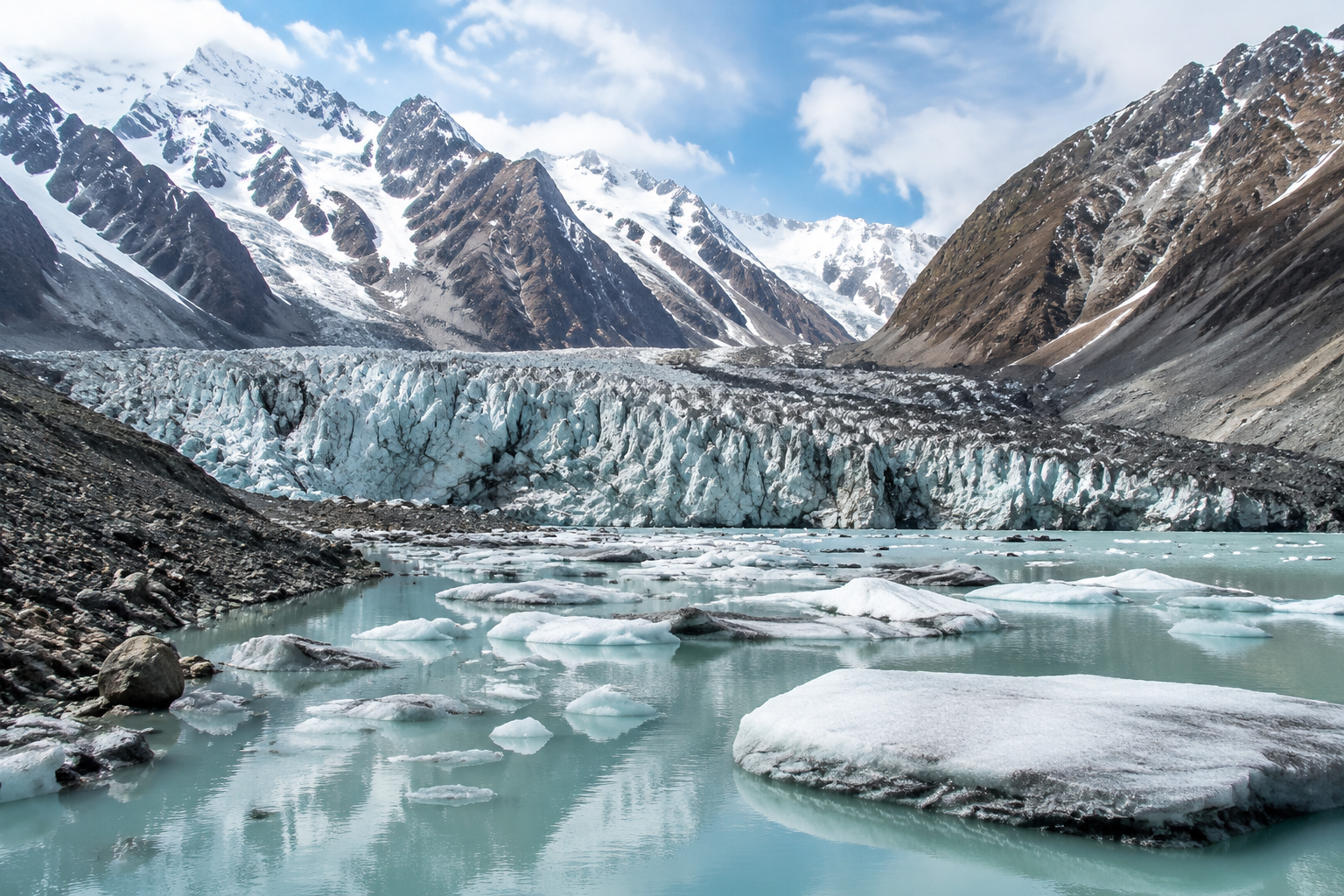
As Pakistan’s frozen mountains transform, the future of its rivers and the millions who depend on them is becoming increasingly uncertain. From the jagged peaks of the Karakoram to the fertile plains of Punjab and Sindh, Pakistan’s water story begins with ice.
Each winter, snow accumulates across the high mountains of the Hindu Kush, Karakoram and Himalaya. As temperatures rise in spring and summer, glaciers slowly release meltwater into streams that merge into the Indus River system, sustaining one of the world’s largest irrigation networks. This seasonal rhythm has supported farming, hydropower, drinking water and livelihoods for generations.
Today, that rhythm is changing. Scientists have documented accelerating glacier loss across the Hindu Kush Himalayan region as global temperatures continue to rise. While Pakistan’s glaciers have not all responded in the same way, some in the Karakoram have remained relatively stable compared with glaciers elsewhere in the region, the broader trend points toward increasing uncertainty in the timing and volume of water flowing through the Indus Basin.
For a country where agriculture contributes significantly to the economy and employs millions of people, the implications extend far beyond the mountains. Yet climate change is not experienced through scientific graphs alone. It is first noticed in the memories of people who have spent their lives among the glaciers.
Recalling changes in Upper Hunza, resident Mirza Hussain told, “I remember during my childhood the snow would reach up to nearly half my body… However, snowfall has declined significantly and sometimes we do not even see snow for the whole year.” His words reflect what many mountain communities describe: winters are becoming less predictable, snowfall patterns are shifting, and familiar landscapes are changing.
Pakistan is home to more than 13,000 glaciers, one of the largest concentrations outside the polar regions. These glaciers act as natural water towers, storing precipitation during colder months and releasing it gradually as temperatures rise. Snow and glacier melt contribute a substantial share of the Indus River’s annual flow, making the country’s water supply unusually dependent on conditions in high-altitude regions.
That dependence is becoming increasingly complex. As glaciers retreat, they often leave behind growing lakes dammed by loose rock and ice. These glacial lakes can remain stable for years before suddenly bursting, releasing torrents of water, mud and debris into valleys below. Known as Glacial Lake Outburst Floods (GLOFs), these events have become an increasing concern for communities across Gilgit-Baltistan and upper Khyber Pakhtunkhwa.
According to government and United Nations programmes working on glacier hazards, Pakistan contains thousands of glacial lakes, dozens of which are considered potentially dangerous because of their likelihood of overflowing or collapsing under changing climatic conditions.
For mountain communities, these risks are deeply personal. Remembering the 2004 Passu Glacier flood, resident Sabrina Khan told: “There was chaos in my village when the news reached us… There was no time to carry our belongings with us.” Her account illustrates how quickly life can change when a glacial lake bursts. Roads disappear, bridges are swept away and villages can become isolated within hours.
Such disasters attract national attention, but they represent only one part of a much larger story.
The greater challenge may lie downstream. The Indus River supports farms stretching across Punjab and Sindh, supplies drinking water to expanding cities and generates electricity through major hydropower projects. Changes in glacier behaviour therefore influence communities hundreds of kilometres away that may never see a glacier themselves.
Hydrologists explain that glacier melt does not immediately produce water scarcity. In many regions, warming temperatures initially increase meltwater, leading to stronger river flows and a higher likelihood of flooding. Over time, however, continued glacier shrinkage may reduce the amount of ice available to sustain rivers during dry periods. The result is not simply less water but greater unpredictability.
That uncertainty affects nearly every sector of society. Farmers depend on reliable irrigation schedules to decide when to sow and harvest crops. Hydropower operators rely on seasonal river flows to generate electricity. Municipal authorities must plan for growing urban demand, while disaster managers face increasingly frequent weather extremes ranging from flash floods to prolonged droughts.
Climate scientists argue that understanding these changes requires looking beyond individual disasters. A flood in Gilgit-Baltistan, a drought in Balochistan and water shortages in Karachi are often discussed as separate crises. In reality, they are interconnected parts of a changing water system shaped by rising temperatures, shifting precipitation patterns and growing pressure on natural resources.
Responding to these challenges will require more than emergency relief. Pakistan has expanded glacier monitoring, installed automatic weather stations and strengthened community-based early warning systems in vulnerable mountain districts. Researchers continue to improve satellite observations and field measurements to better understand how glaciers are evolving.
Speaking during the launch of a national glacier risk reduction initiative, former Additional Secretary for Climate Change Shakeel Malik warned that glacial lake outburst floods can release enormous volumes of water and debris, destroying infrastructure and threatening lives in some of Pakistan’s most remote communities. His remarks underline the importance of preparing for hazards before they become disasters.
Adaptation, however, extends beyond monitoring glaciers. Experts increasingly point to modern irrigation, improved water storage, watershed protection, stronger local institutions and better coordination between scientific agencies and policymakers as essential elements of Pakistan’s long-term response. They also stress the importance of involving mountain communities, whose local knowledge complements scientific observation.
The glaciers feeding Pakistan’s rivers do not recognise political borders. They form part of the broader Hindu Kush Himalayan system that supports major rivers flowing across South Asia. Their future therefore carries regional significance, linking climate change in mountain landscapes to food production, energy security and water availability across the subcontinent.
For generations, Pakistan inherited rivers shaped by stable patterns of snowfall and seasonal melting. Those patterns are becoming less certain. The country’s challenge is no longer simply protecting glaciers from a warming climate—a task beyond the reach of any single nation. It is learning to manage water in an era when the mountains that have long sustained life are themselves being transformed.
The story of Pakistan’s glaciers is not only about disappearing ice. It is about the future of farms in the plains, cities facing growing demand, communities rebuilding after floods and a generation that must rethink how one of the world’s most water-dependent countries lives with its most precious resource.
The ice may lie hundreds of kilometres away, but its future is inseparable from Pakistan’s own.
