

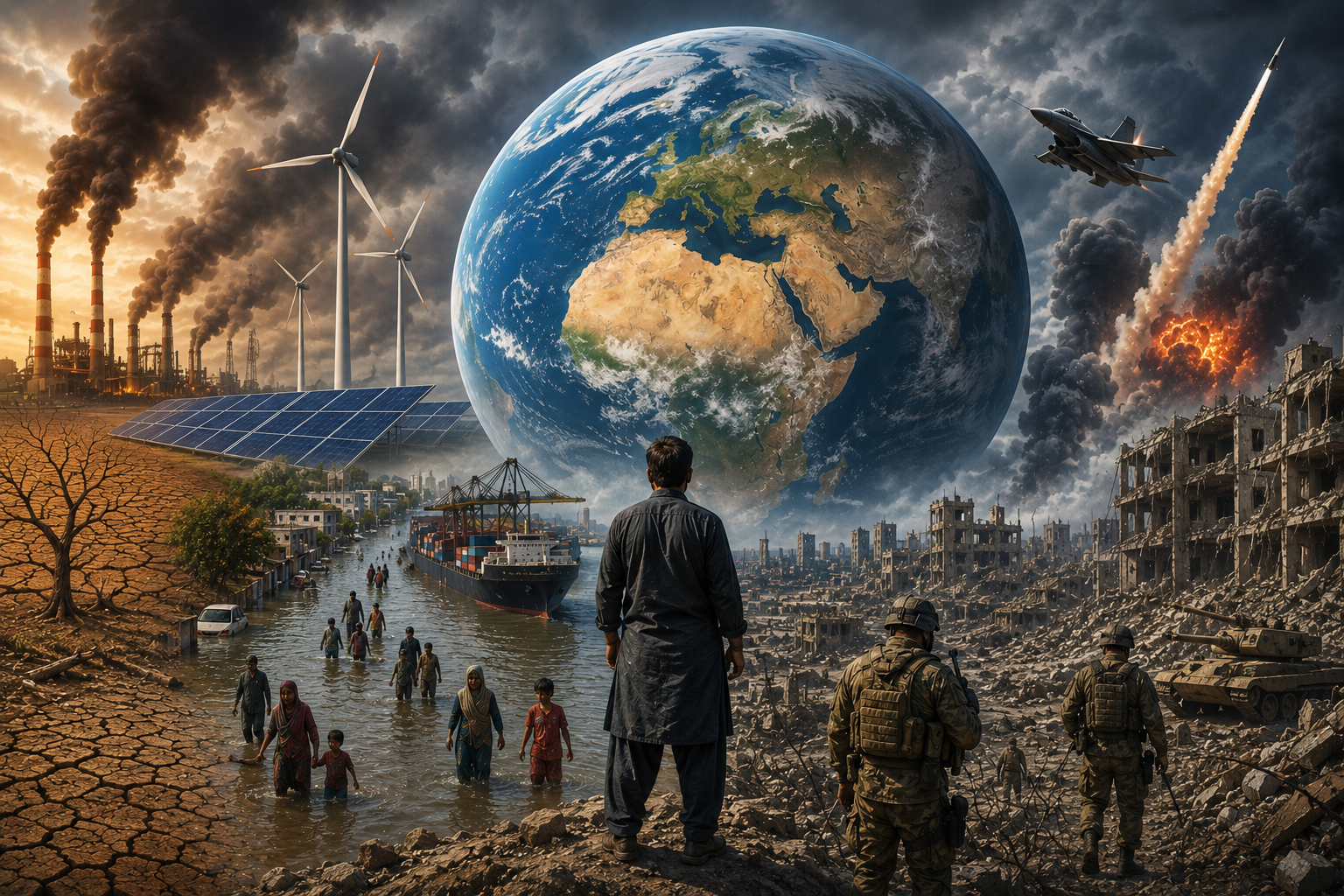
The world in 2026 appears to be entering a period of profound uncertainty where multiple crises are no longer unfolding separately but increasingly feeding into one another. Geopolitical conflicts, climate emergencies, economic instability, energy insecurity, technological disruption, and rising global competition are converging at a pace that is reshaping international politics and everyday life alike.
What makes the current moment particularly significant is that these challenges are no longer confined to one region. A war in the Middle East affects fuel prices in South Asia. Climate disasters in one continent disrupt food supplies in another. Strategic rivalry between major powers influences trade routes, investment flows, and security calculations across developing countries.
For countries like Pakistan, these global shifts are not distant events observed through television screens. They are increasingly becoming domestic realities with direct consequences for economic stability, national security, energy supplies, and climate resilience.
One of the most important developments shaping the international landscape is the growing instability in the Middle East. The region remains central to global energy markets, and any disruption there immediately affects oil-importing countries across Asia. Analysts warn that geopolitical tensions involving Iran and regional powers continue to create uncertainty in global energy markets, raising concerns over inflation, supply chains, and economic growth.
For Pakistan, this is particularly important. The country remains heavily dependent on imported energy and is vulnerable to fluctuations in global oil prices. Higher fuel costs quickly translate into rising transport expenses, electricity tariffs, industrial production costs, and inflation. This means geopolitical crises thousands of kilometers away can directly affect household budgets in Pakistani cities and villages.
At the same time, Pakistan has attempted to position itself as a diplomatic bridge in a rapidly changing region. Recent international assessments have highlighted Islamabad’s role in facilitating dialogue and maintaining balanced relations with competing regional actors. Pakistan’s growing engagement in regional diplomacy reflects a broader effort to remain relevant in an increasingly fragmented international order.
Another major trend defining 2026 is the acceleration of global power competition. The world is gradually moving away from the unipolar system that emerged after the Cold War toward a more fragmented and competitive environment. China, the United States, India, Russia, the European Union, and regional powers are all attempting to secure influence in strategic regions, critical trade routes, technology sectors, and supply chains.
This geopolitical competition has significant implications for Pakistan because of its geographic position. Situated at the crossroads of South Asia, Central Asia, the Middle East, and China, Pakistan occupies a strategically important location in emerging connectivity projects.
The China-Pakistan Economic Corridor (CPEC), once viewed primarily as an infrastructure initiative, is increasingly being discussed in broader geopolitical and geo-economic terms. China and Pakistan recently reaffirmed their commitment to expanding cooperation, strengthening connectivity, and developing Gwadar as a regional trade hub. This suggests that Pakistan could play a larger role in regional commerce if stability and security challenges are managed effectively.
However, opportunities come with risks.
The competition between major powers often places middle-sized states under pressure to balance relationships carefully. Pakistan must simultaneously maintain ties with China, engage constructively with Western economies, preserve relations with Gulf states, and manage a complicated relationship with neighboring India.
The India-Pakistan relationship remains one of the most consequential factors affecting regional stability. Water security has become an increasingly important issue in bilateral relations. Discussions surrounding the Indus Waters Treaty continue to carry strategic significance because climate change, population growth, and agricultural pressures are increasing competition over water resources.
Water may become one of the defining geopolitical issues of the coming decades.
While military conflicts often dominate headlines, climate change is emerging as a threat with potentially even greater long-term consequences. Scientists and international organizations increasingly describe climate change as a “risk multiplier” because it intensifies existing economic, political, and social vulnerabilities.
Recent warnings from climate experts suggest that the world is highly likely to experience record-breaking temperatures before the end of the decade. The probability of exceeding critical warming thresholds is rising, raising concerns about extreme weather, droughts, floods, food insecurity, and public health emergencies.
Pakistan stands among the countries most exposed to these risks.
The country has already witnessed devastating floods, recurring heatwaves, water shortages, glacial melt, and agricultural disruptions. During recent heat events, temperatures in parts of Pakistan crossed dangerous levels, placing enormous pressure on health systems and electricity infrastructure.
Climate change is no longer simply an environmental issue for Pakistan. It has become a national security challenge, an economic challenge, and a development challenge.
Farmers face unpredictable rainfall patterns. Urban populations confront worsening heat stress. Energy demand rises during extreme temperatures. Water resources become increasingly contested. These interconnected pressures demonstrate how climate risks are transforming governance and policy priorities.
At the same time, misinformation and technological disruption are emerging as parallel challenges. Artificial intelligence has begun transforming media, politics, education, and business. While AI offers significant opportunities for productivity and innovation, it also creates new risks.
Deepfakes, manipulated videos, and AI-generated misinformation have become increasingly difficult to distinguish from reality. Around the world, governments, journalists, and technology companies are struggling to develop frameworks that preserve trust in information ecosystems.
For Pakistan, where social media increasingly shapes public discourse, the spread of AI-generated misinformation could have significant political, social, and security implications. The challenge will not simply be technological. It will involve strengthening media literacy, improving fact-checking systems, and building public trust in credible journalism.
Economic uncertainty represents another defining feature of 2026.
Global institutions increasingly warn about geo-economic fragmentation, where political rivalries begin disrupting trade relationships and investment flows. The World Economic Forum has identified geo-economic confrontation among the leading risks facing the international system.
For developing economies such as Pakistan, this environment creates difficult choices. Governments must pursue growth while managing debt, inflation, energy costs, and external vulnerabilities. Attracting investment becomes more challenging when investors face uncertainty regarding global markets, geopolitical tensions, and supply chains.
Yet periods of global disruption also create openings.
Countries that successfully position themselves within new trade corridors, renewable energy transitions, digital economies, and regional connectivity networks may benefit from shifting economic patterns. Pakistan’s large youth population, strategic geography, and expanding technology sector provide potential advantages if supported by long-term policy planning.
Perhaps the most important lesson from recent global developments is that traditional distinctions between domestic and international affairs are becoming increasingly blurred.
A conflict in the Gulf can influence electricity prices in Karachi. Climate events in one region can affect food prices in Lahore. Decisions made in Beijing, Washington, Brussels, or New Delhi can shape investment opportunities in Gwadar or Faisalabad.
The world is becoming more interconnected, but also more fragile.
The defining challenge for policymakers in 2026 is therefore not merely responding to individual crises. It is understanding how these crises interact with one another. Climate change influences migration. Energy insecurity drives inflation. Geopolitical tensions affect trade. Technological disruption reshapes politics.
Pakistan finds itself at the center of many of these global trends. Its future will depend not only on domestic reforms but also on how effectively it navigates a rapidly changing international environment.
The coming years may ultimately determine whether countries can adapt to this new era of interconnected risks or whether global instability becomes the defining story of the decade.
