


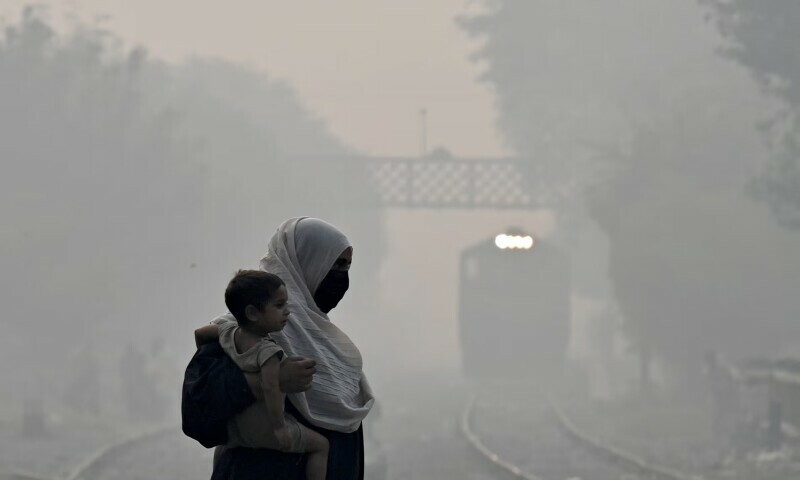
Islamabad: In many parts of Pakistan, pregnancy is usually discussed in terms of diet, rest, medical checkups, and hospital access. These are the visible parts of maternal care. But there is another factor that rarely enters conversations between doctors and expectant mothers, even though it surrounds them every hour of the day. It is the air they breathe.
Across urban centers like Lahore, Karachi, Faisalabad, Multan, and Peshawar, and even in smaller industrial towns, pregnant women are exposed to air that often exceeds safe health limits by many times, especially during winter smog seasons. While this exposure is invisible, doctors are increasingly concerned that its effects are not.
In maternity wards and gynecology clinics, a quiet pattern is being observed. Some babies are born smaller than expected. Some arrive with weak breathing. Some need immediate oxygen support in the first minutes of life. These cases do not always point to a single cause, but health professionals say environmental exposure is becoming harder to ignore as one of the contributing factors.
A senior gynecologist working in a public hospital in Lahore describes what she is seeing in simple terms. “We counsel mothers about nutrition, anemia, and supplements. But we rarely talk about air quality, even though they are breathing it every day during pregnancy. Over time, you start to wonder what role it is playing.”
She pauses before adding, “We are not saying it is the only cause. But it is a risk that surrounds all of them equally, regardless of income or awareness.”
Pakistan’s air quality situation provides context to these concerns. According to global air quality guidelines, long-term exposure to fine particulate matter, known as PM2.5, should not exceed 5 micrograms per cubic meter. However, in many Pakistani cities, readings frequently rise several times higher than this threshold, especially during winter months when smog becomes dense and persistent.
In some urban monitoring reports, levels have been recorded at 50, 100, or even higher micrograms per cubic meter during peak pollution days. These particles are extremely small, invisible to the naked eye, and capable of entering deep into the lungs and bloodstream.
A public health researcher in Islamabad explains why this matters specifically for pregnancy. “When a pregnant woman is exposed to polluted air, the concern is not only about her lungs. It is about oxygen exchange, inflammation, and how these biological changes can affect fetal development over time.”
He adds that research from multiple countries has found associations between high pollution exposure during pregnancy and outcomes such as low birth weight, preterm birth, and restricted fetal growth. While these are risk associations rather than direct causes in every case, they are strong enough to raise concern in public health planning.
In hospitals, these patterns are not recorded under a single label like “air pollution related pregnancy complications.” Instead, they appear in different forms, scattered across records as low birth weight, mild respiratory distress, or premature delivery.
A senior nurse in a maternity ward in Karachi describes how this appears in daily work. “We do not label it as pollution, but we notice more fragile newborns during certain months. Babies who need extra care or oxygen support. It feels more frequent when the air outside is heavy.”
She is careful not to draw absolute conclusions, but the repetition of cases leaves an impression that is difficult to ignore for those working closely with mothers and newborns.
Doctors say one of the challenges is that pregnancy outcomes are influenced by many factors at the same time. Nutrition, maternal age, access to healthcare, infections, and socioeconomic conditions all play important roles. Air pollution does not replace these factors, but it adds another layer of risk that is difficult to isolate in clinical settings.
A gynecologist in Rawalpindi explains it in a more practical way. “If a mother is already anemic, or if she is not getting proper nutrition, and on top of that she is exposed to polluted air every day, then the body is under multiple stresses. It becomes harder to separate one cause from another, but the combined effect matters.”
For many pregnant women in Pakistan, avoiding polluted air is not a realistic option. Daily life continues through busy roads, crowded transport, markets, and workplaces where air quality is rarely controlled or filtered.
A schoolteacher in Lahore who is in her third trimester describes her experience during winter smog. “I can feel the difference in my breathing when the smog gets worse. I get tired faster, I feel heaviness in my chest. But I still have to go to school and travel through traffic every day.”
She says that during her prenatal visits, air pollution was never discussed. “No one told me that the air itself could affect my pregnancy. We talk about food, vitamins, and rest. Not the air.” Her experience reflects a broader gap between environmental health research and public awareness at the individual level.
Globally, scientific studies over the past decade have strengthened the understanding of how air pollution exposure during pregnancy can influence fetal development. Research from large population studies in different countries has shown links between high levels of particulate matter exposure and lower birth weight, increased risk of preterm delivery, and restricted fetal growth.
The biological explanation is increasingly supported by medical research. Fine particles can trigger inflammation in the mother’s body, affect oxygen transport efficiency, and influence placental function, which plays a critical role in delivering nutrients and oxygen to the developing fetus.
A pulmonologist in Karachi explains this connection in simple language. “The placenta is the lifeline between mother and baby. If the mother is exposed to polluted air regularly, it can affect oxygen levels and create stress in the body. That stress can indirectly affect the baby’s growth environment.”
He emphasizes that this does not mean pollution alone determines outcomes, but it is a contributing environmental pressure that should not be overlooked.
Despite growing scientific evidence globally, Pakistan still lacks widespread integration of air quality awareness into maternal healthcare guidance. Doctors routinely advise on iron intake, blood pressure monitoring, and ultrasound checkups, but environmental exposure is not yet part of standard counseling in most public health settings.
A senior public health expert in Islamabad highlights this gap. “Our healthcare system is focused on treating conditions rather than preventing environmental risks. Air pollution is still seen as an external issue, not a clinical concern, even though it affects patients directly.”
He believes that without integrating environmental health into maternal care programs, a key risk factor will continue to remain outside formal prevention strategies.
Another challenge is the lack of localized long-term studies that directly connect pregnancy outcomes with air pollution exposure in Pakistan’s specific urban and rural contexts. While international research provides strong evidence, local data integration remains limited.
A researcher working in environmental health policy explains this issue. “We rely heavily on global studies, which are very important. But we need Pakistan-specific data that connects hospital records with air quality trends. Without that, policy responses remain general rather than targeted.”
He adds that such integration would help identify high-risk areas and seasons more clearly, especially during smog peaks.
In maternity wards, doctors continue to focus on immediate care. A baby is either healthy, or it needs support. But behind those immediate outcomes, there is a longer environmental timeline that begins months earlier, often outside hospital walls.
A pediatric specialist in Lahore reflects on this quiet reality. “We see the result at birth. But the exposure starts much earlier. Pregnancy is a sensitive period, and whatever the mother breathes becomes part of that environment.”
As Pakistan’s cities expand and traffic increases, exposure to polluted air remains a constant part of daily life for millions of women. Unlike other risk factors, it cannot be easily controlled at an individual level without broader environmental change.
In the end, the concern raised by doctors is not about a single diagnosis or a direct cause-effect conclusion. It is about accumulation. About repeated exposure over months of pregnancy. About environmental stress that is shared across populations but experienced most quietly by those carrying new life.
Back in a hospital corridor, a young mother holding her newborn answers a simple question about her pregnancy journey. She hesitates before speaking. “I did everything the doctors told me. I ate properly, I took my medicines. But I was always worried about the air outside. I did not know what it might be doing.”
Her words capture what many doctors are now trying to understand more clearly. That pregnancy does not happen in isolation. It happens inside an environment that is changing faster than the guidance given to those who must live in it.
And for many mothers in Pakistan, that environment begins with every breath taken long before the first cry of a newborn is heard.
