


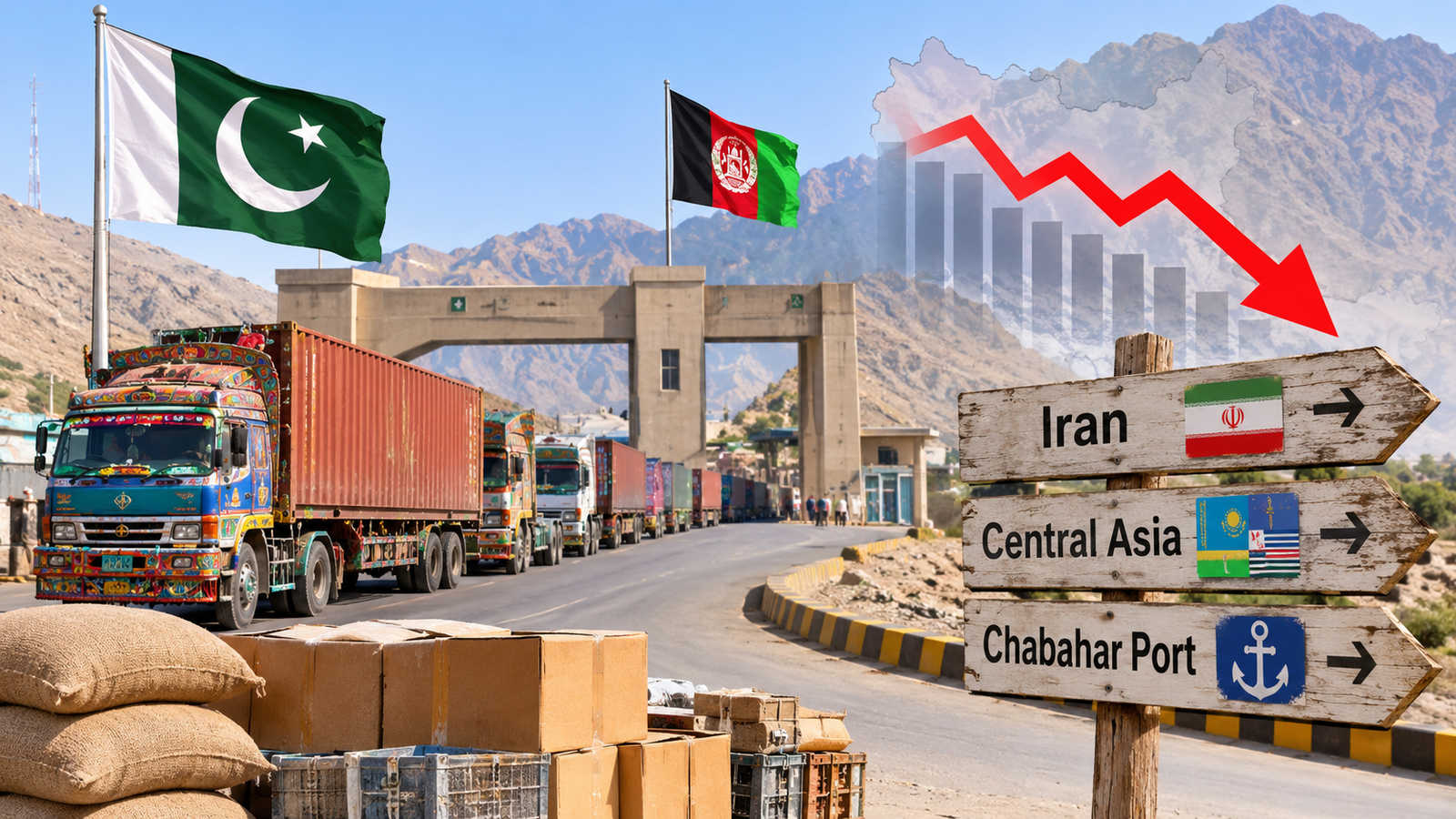
For decades, Pakistan was Afghanistan’s main commercial gateway to the sea. Afghan traders used Pakistani roads and ports to bring goods into the landlocked country, while Pakistani exporters supplied Afghanistan with food, medicines, construction materials, machinery and consumer goods. Thousands of traders, transporters, customs agents and other businesses on both sides of the border built their livelihoods around this trade. But that relationship is changing rapidly as political tensions, security concerns and repeated border closures push Afghan traders towards alternative routes through Iran and Central Asia.
The change matters to Pakistan because Afghanistan was one of the few neighbouring markets where Pakistani exports consistently exceeded imports. According to Pakistan’s Ministry of Foreign Affairs, based on data from the Federal Board of Revenue and State Bank of Pakistan, Pakistan exported goods worth $1.02 billion to Afghanistan in 2020-21 while importing $577.5 million, giving it a trade surplus of about $441 million. The surplus narrowed to $66 million in 2021-22 and $61 million in 2022-23, before increasing to $526 million in 2023-24 as Pakistani exports reached $1.06 billion against imports of $538.6 million.
The official figures show another striking development in 2024-25. Pakistani exports to Afghanistan rose to about $1.34 billion, while recorded imports fell to only $37.9 million, producing a reported surplus of more than $1.3 billion. That unusually large fall in imports should, however, be treated carefully because Pakistani and Afghan trade statistics can differ because of customs classifications, valuation methods, informal trade and differences in the period used for reporting. The figures establish Pakistan’s strong export position, but they should not be used alone to calculate the actual economic benefit or profit generated by this trade.
Pakistan’s export relationship with Afghanistan was built around a relatively wide range of products. Rice, fruits and vegetables, pharmaceuticals, food preparations, cement, plastics, motorcycles, tractors, sugar confectionery and rubber products were among the goods supplied by Pakistani businesses. Afghan traders, meanwhile, supplied Pakistan with agricultural products such as grapes, apples, onions, tomatoes, dried fruits and lentils, along with commodities including coal, cotton and lead. The relationship therefore connected Pakistani manufacturers and farmers with Afghan consumers while providing Afghan producers access to one of their closest major markets.
That commercial relationship has increasingly been affected by political and security tensions. The latest major disruption came in October 2025, when Pakistan and Afghanistan closed major crossing points following heightened security tensions. Pakistan’s government reported that hundreds of vehicles were stranded at Torkham and Chaman, including transit cargo waiting to cross the border. At Torkham, around 255 export vehicles were inside the terminal and another 200 were reportedly stranded along the Jamrud-Landi Kotal road, while customs clearance at Chaman had been suspended.
For traders, a border closure is more than a diplomatic or security development. A truck waiting for days means additional fuel and parking costs, a delayed payment for the exporter and a delayed shipment for the importer. For perishable goods, the consequences can be much worse because fruit and vegetables can lose their value before reaching the market. The impact also spreads to customs agents, warehouses, freight companies, mechanics, fuel stations and other businesses that depend on the movement of goods across the border.
But the latest crisis did not create Afghanistan’s search for alternative trade routes. The shift had been developing for several years as Afghan traders and policymakers sought to reduce their dependence on a single route through Pakistan. Afghanistan’s landlocked geography makes access to seaports essential, and Iran’s Chabahar port has increasingly emerged as an alternative gateway. At the same time, road and rail connections through Uzbekistan, Turkmenistan and Tajikistan have provided additional options for trade with Central Asia and beyond.
The significance of this diversification became clearer in 2025. Reuters reported in January 2026 that Afghanistan’s total trade reached nearly $13.9 billion during 2025 despite repeated closures along its Pakistani border. Afghan imports exceeded $12.1 billion while exports were around $1.8 billion, with alternative routes through Iran and Central Asia helping the country maintain commercial flows. Afghanistan’s trade did not stop when its traditional route became unreliable; traders found other ways to move goods.
This is where Pakistan’s problem becomes more serious than the immediate loss of export orders. A temporary border closure can be reversed, but once traders establish alternative suppliers, shipping arrangements and transport corridors, some of that business may not automatically return. An Afghan importer who once bought from Pakistan may begin sourcing from Iran, China or another supplier. A transport company may invest in a different route. Over time, these decisions can turn a temporary disruption into a permanent change in trading patterns.
The decline in Pakistan’s transit trade provides some of the clearest evidence of this shift. According to figures reported by Dawn, transit cargo through Pakistan fell to 11,592 containers worth about $367 million in FY2025-26, compared with nearly 89,000 containers valued at around $5 billion before the Taliban returned to power in 2021. That represents a fall of roughly 87 percent in container numbers and more than 90 percent in the reported value of transit cargo. Reverse transit trade also fell from $454 million in FY2024-25 to only $7 million in FY2025-26.
These numbers need to be understood correctly. The $5 billion of earlier transit cargo does not represent $5 billion of income for Pakistan, just as the fall to $367 million does not mean Pakistan lost $4.6 billion from its economy. The cargo belongs to traders and companies using Pakistan as a transit route. Pakistan earns from ports, transport, customs, warehousing, handling and other services associated with that trade. The real economic loss to Pakistan would therefore need to be calculated from those earnings rather than the gross value of the goods themselves.
The same distinction is important when assessing estimates of Pakistan’s overall losses. A Pakistan Institute of Development Economics estimate cited in local reporting put the cost of the border closure to Pakistani exporters at around $4.5 billion. Such an estimate can be useful for understanding the scale of the disruption, but it should not be described as a verified cash loss to Pakistan’s economy without examining the methodology behind it. Lost potential sales, reduced business activity and actual financial losses are different measurements.
What can be measured more directly is the decline in Pakistan’s exports. State Bank of Pakistan figures reported by Dawn show that exports to Afghanistan fell to about $243.7 million in FY2025-26 from $783.9 million in FY2024-25, a decline of almost 69 percent. Imports from Afghanistan also fell sharply, from $25.9 million to $6.5 million. The collapse came after a period in which Pakistani exports had actually been recovering, making the subsequent decline particularly significant for businesses that had expected the Afghan market to continue growing.
The loss is not limited to Afghan consumers. Pakistan has also been trying to use Afghanistan as a land bridge to Central Asia, where it sees an opportunity to expand exports and connect its ports with markets in Uzbekistan, Tajikistan, Turkmenistan, Kyrgyzstan and Kazakhstan. But the disruption of the Afghan corridor makes that ambition more difficult. Pakistan’s exports to five Central Asian states fell to about $148 million during July-April FY2025-26 from $161.9 million in the corresponding period a year earlier, according to figures reported by Dawn.
The longer-term concern is that alternative routes may gradually become commercially normal. Iran’s Chabahar port gives Afghanistan access to the sea without relying on Pakistan, while northern routes provide connections to Central Asian markets. China and the United Arab Emirates are also important sources of Afghan imports. India remains an important destination for Afghan exports, particularly agricultural products. The more these routes are used, the more infrastructure, commercial relationships and experience develop around them.
Pakistan’s traditional advantage has been geography. Karachi and Port Qasim are relatively close to Afghanistan compared with some alternative routes, and Pakistan has established road networks, customs infrastructure and a large transport industry serving Afghan trade. But geographical proximity alone does not guarantee commercial dominance. For an importer, a longer route that is predictable can sometimes be more attractive than a shorter route that can suddenly close.
That is why reliability has become as important as distance. An exporter needs to know how long a shipment will take, how much it will cost and whether the border will remain open. Repeated closures increase uncertainty, raise inventory costs and can make buyers look for alternative suppliers. For perishable goods, even a relatively short delay can turn a profitable shipment into a loss.
The effects can be seen in the behaviour of Afghan traders. Reuters reported that Afghanistan’s trade remained resilient in 2025 even as its border with Pakistan experienced repeated closures. The country increasingly relied on Iran and Central Asian routes to maintain imports and exports. This does not mean Afghanistan has abandoned Pakistan, nor does it mean Pakistani products are no longer competitive. It does show, however, that Afghan businesses have demonstrated that they can diversify their supply chains when one corridor becomes unreliable.
That diversification could make the eventual recovery of Pakistan-Afghanistan trade more complicated. If a Pakistani rice exporter loses an Afghan customer during a prolonged border closure, the customer may initially wait for the border to reopen. But if the closure continues, the importer has an incentive to find another supplier. Once a new supplier is tested and a new transport route is established, the original Pakistani exporter has to win that customer back rather than simply resume the previous relationship.
The same applies to Pakistani pharmaceutical companies, cement manufacturers, food exporters and other businesses that have traditionally relied on Afghanistan. The economic cost of the disruption therefore cannot be measured only by comparing one year’s exports with another. Some lost sales may return when the border opens, while others may have already shifted to competitors.
This is also why the future of Pakistan’s trade with Afghanistan matters beyond the two countries. Pakistan has repeatedly presented its geographical location as a potential gateway between the Arabian Sea, Afghanistan and Central Asia. A successful regional trade strategy would allow Pakistani ports and transport networks to benefit not only from Afghan demand but also from trade between Central Asia and global markets.
But the current situation exposes the weakness of that model. A country cannot easily become a regional trade hub if traders cannot depend on its corridors. The value of a port or highway is not determined only by its location; it also depends on the reliability of the network connected to it.
For Afghanistan, the incentive to diversify is equally understandable. As a landlocked economy, it cannot afford to depend entirely on one neighbouring country for access to international markets. Alternative corridors give Afghan businesses greater choice and reduce the economic impact of a closure at any single border. The cost may sometimes be higher, but diversification itself has economic value.
The result is a paradox. Pakistan remains geographically well placed to serve Afghanistan and Central Asia, yet that geographical advantage is becoming less decisive. Afghanistan is building a more diversified trading system at the same time that Pakistan is trying to position itself as a regional connectivity hub.
The numbers tell part of that story. Pakistan exported more than $1 billion in goods to Afghanistan in several recent years. Transit cargo that once amounted to nearly 89,000 containers and about $5 billion in value has fallen to 11,592 containers worth $367 million. Pakistan’s exports to Afghanistan subsequently fell sharply, while Afghanistan’s overall trade continued despite the disruption by using other corridors.
The question, therefore, is not simply how much money Pakistan has lost because of the border closures. It is whether Pakistan is losing a commercial position that took decades to build.
If the disruption is temporary and political relations improve, some trade could return because Pakistan retains the advantages of proximity, established infrastructure and existing business relationships. But if Afghan importers and exporters become permanently accustomed to alternative routes, Pakistan may find that reopening the border is not enough to restore the old pattern of trade.
For Pakistan, the cost of the current crisis may ultimately be measured not only in the value of trucks that stopped at Torkham or Chaman, or in the decline in annual export receipts. It may be measured in the customers, routes and commercial relationships that moved elsewhere while the traditional corridor was closed.
The geography has not changed. Afghanistan is still landlocked, Pakistan is still its neighbour and Karachi is still closer to much of Afghanistan than many alternative seaports.
What has changed is the calculation of risk. And for traders, a reliable longer route can eventually become more valuable than an unreliable shorter one.
