


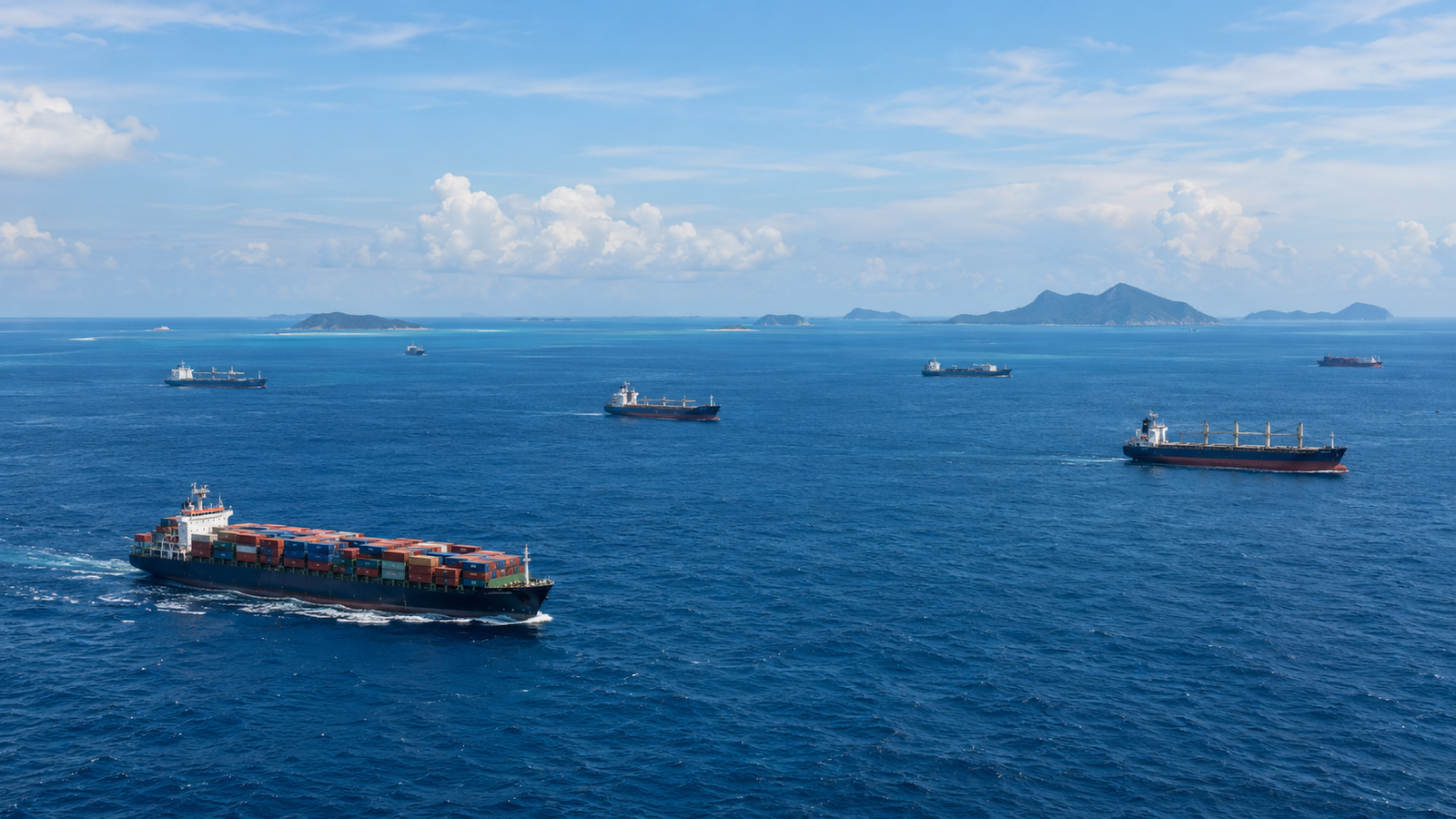
The next maritime crisis in Asia may not begin with a warship crossing a disputed boundary or a missile being fired across contested waters. It could begin with something far less visible: a cable lying quietly on the seabed.
Thousands of metres below the surface, networks of fibre-optic cables connect countries, financial centres, data centres and communications networks across the Indo-Pacific. They carry the digital traffic that makes modern economies function, from internet searches and video calls to banking transactions, cloud services, government communications and business data. The International Telecommunication Union says submarine telecommunications cables carry more than 99 percent of international data exchange, making them one of the least visible but most important pieces of global infrastructure.
That makes the seabed a new frontier of maritime security. For decades, discussions about the South China Sea have focused on islands, reefs, naval patrols, fishing grounds, energy resources and competing territorial claims. But beneath those waters lies another layer of strategic importance: the digital infrastructure connecting some of the world’s most economically important societies.
The South China Sea is particularly significant because it sits within a dense network of communications routes connecting East and Southeast Asia with South Asia, the Middle East and Europe. The region’s importance is not simply about where cables are located. It is also about the landing stations, repair vessels, cable operators, maritime routes and coastal infrastructure on which those cables depend. A disruption at one point can potentially affect services far beyond the place where the cable is physically damaged.
A 2026 study published in Contemporary Security Policy describes submarine cables as a form of “digital sea lines of communication” and argues that the South China Sea is increasingly becoming a space where maritime competition and digital infrastructure intersect. The study notes that cable routing, construction, maintenance and repair are no longer purely commercial matters when they take place in contested waters and amid growing strategic rivalry.
The basic technology is remarkably simple in concept. A submarine communications cable contains optical fibres through which information travels as pulses of light. Protective layers surround the fibres, allowing the cable to survive the pressure and conditions of the deep ocean. Near shore, where fishing, anchoring and other human activity are more common, cables can receive additional protection. But despite that engineering, they remain physical objects in a crowded and increasingly contested maritime environment.
And that is where the security problem begins.
A cable does not need to be deliberately attacked to create a major disruption. The International Cable Protection Committee estimates that around 150 to 200 submarine telecommunications cable faults occur globally each year, with about 70 to 80 percent caused by accidental human activity, particularly fishing and ships’ anchors.
This distinction is important. The growing discussion about cable security can easily create the impression that every break is an act of sabotage. In reality, most damage is accidental. But the same vulnerability that allows an anchor or fishing gear to damage a cable can also create an opportunity for deliberate interference.
That possibility has become more important as governments increasingly regard subsea infrastructure as critical national infrastructure. In recent years, incidents involving cables and other underwater infrastructure in different parts of the world have demonstrated how difficult it can be to determine exactly what happened beneath the sea. The European Union has warned that incidents affecting cables in the Baltic Sea, Red Sea, Taiwan Strait and South China Sea demonstrate vulnerabilities to hybrid and covert interference, while the underwater environment can make attribution particularly difficult.
The challenge is especially complicated in the South China Sea because the seabed is not politically neutral territory. Several countries have competing maritime claims, while commercial vessels, fishing fleets, coast guards, naval forces and other government vessels operate in the same broad space.
A damaged cable therefore raises questions that go beyond engineering. Was the damage accidental? Was a vessel aware that a cable was present? Was the vessel operating legally? Was the cable in territorial waters, an exclusive economic zone or an area beyond national jurisdiction? Who has the authority to investigate? Which country can prosecute those responsible? And, perhaps most difficult of all, how can governments distinguish an ordinary maritime accident from deliberate interference designed to remain below the threshold of armed conflict?
These questions expose an important gap between the speed of technological change and the age of some international legal rules.
The United Nations Convention on the Law of the Sea, or UNCLOS, provides a legal framework for submarine cables. Article 112 recognises the right of states to lay submarine cables and pipelines on the bed of the high seas beyond the continental shelf. Article 79 similarly establishes the right to lay cables on the continental shelf, while placing certain limits on the ability of coastal states to impede their installation and maintenance.
UNCLOS also addresses damage. Article 113 requires states to adopt laws making the wilful or culpably negligent breaking or injury of submarine cables a punishable offence in circumstances covered by the provision. Articles 114 and 115 address responsibility and compensation in cases involving damage caused during cable operations or damage avoided by ships sacrificing anchors or fishing gear.
But the legal framework was developed before today’s digital economy existed in anything like its current form. Modern submarine cables carry enormous volumes of data, and the potential threat is no longer limited to physically cutting a cable. Cyber interference, surveillance, manipulation of digital infrastructure and the use of civilian maritime activity for strategic purposes create new questions that are not easily answered by provisions originally designed around physical damage.
This is one reason the South China Sea matters beyond the countries that claim territory there. The cables passing through the region are part of a much larger network.
The latest global submarine cable maps show the scale of that network. TeleGeography’s 2026 map identifies 694 cable systems and 1,893 landing stations either active or under construction around the world. Singapore, in particular, is one of the major regional hubs, with numerous systems connecting Southeast Asia with Japan, China, Taiwan, South Asia and other parts of the global network.
This creates what might be called a digital geography of the sea. A country does not need to control an entire maritime route to have influence over connectivity. Control or vulnerability at a landing station, chokepoint, repair route or heavily concentrated cable corridor can have consequences far beyond the immediate location.
That is why redundancy has become one of the most important concepts in cable security.
If a country depends heavily on one cable or one route, a single failure can have an outsized impact. If several independent systems connect the same country through different routes, traffic can potentially be shifted when one system fails. The objective is not to make cables impossible to damage. That would be unrealistic. The objective is to ensure that one damaged cable does not become a national communications crisis.
Taiwan offers an important example of this challenge. In 2026, its Ministry of Digital Affairs reported repairs to the Taiwan-Matsu Subsea Cable No. 2 after a complete disruption, while also describing the use of alternative systems and satellite and microwave links to strengthen resilience. Taiwan has designated its submarine cables as critical infrastructure and has been developing a “redundancy upon redundancy” approach to ensure communications continue when subsea systems fail.
The lesson is relevant throughout the Indo-Pacific. Resilience cannot depend solely on preventing damage. It also requires alternative cables, satellite links, terrestrial fibre, microwave systems, emergency capacity and the ability to rapidly repair damaged infrastructure.
Repair itself is another overlooked dimension of maritime security.
When a cable breaks, fixing it is not simply a matter of sending an engineer into the ocean. Specialised cable-repair vessels have to locate the fault, reach the area, recover the cable, remove the damaged section and splice in a replacement before lowering it back to the seabed. Weather, sea conditions, maritime permissions, security concerns and the availability of specialised vessels can all influence how quickly the repair is completed.
The International Cable Protection Committee says the global industry has established repair vessels, specialist engineering capabilities and cooperative maintenance arrangements, but it also stresses the importance of government-industry cooperation and timely permits for repair operations.
That creates another potential vulnerability in contested waters. A cable may be physically damaged in minutes, but restoring it can take considerably longer if a repair vessel cannot safely or legally reach the location.
In a geopolitical crisis, that problem could become even more serious. A repair vessel operating in disputed waters could itself become a security concern. Governments might worry about surveillance. Operators might face delays in obtaining permission. Naval or coast guard vessels could monitor the operation. Competing claims could complicate decisions about who has jurisdiction over the repair site.
The cable itself therefore becomes only one part of the security equation. The vessels that install and repair it, the companies that own it, the landing stations that receive it and the states through which it passes all become part of the infrastructure’s security chain.
Ownership adds another layer of complexity.
Unlike traditional military infrastructure, submarine cables are often built and operated through partnerships involving telecommunications companies, technology companies, state-linked entities and international consortia. This commercial structure can increase investment and connectivity, but it can also create complicated questions about national security and strategic dependence.
The SEA-ME-WE 6 system illustrates the point. Pakistan’s government said in 2025 that the 19,200-kilometre system connecting Southeast Asia, the Middle East and Western Europe had strengthened Pakistan’s international digital connectivity. The system has more than 100 Tbps of total capacity, with Pakistan allocated 13.2 Tbps and 4 Tbps activated initially, according to Pakistan’s Press Information Department.
For Pakistan, this is more than a telecommunications story.
Pakistan sits on the Arabian Sea at the western edge of the broader Indian Ocean network. Its digital connectivity depends on submarine cables that connect the country to international networks. That means the country’s economic and digital future is linked not only to what happens along its coastline but also to the security and resilience of the wider maritime routes through which its communications travel.
Pakistan’s growing digital economy makes that dependence increasingly important. Banking, e-commerce, cloud services, digital media, education, government services and businesses all depend on international connectivity. A prolonged disruption would therefore not remain a problem for telecommunications companies. It could affect ordinary users, businesses and public institutions.
The arrival of SEA-ME-WE 6 is significant precisely because additional capacity and route diversity can reduce dependence on individual systems. But redundancy is only useful if it is geographically meaningful. If several cables are concentrated along similar maritime routes or pass through the same vulnerable areas, a single incident could potentially affect multiple systems.
This is where Pakistan can draw lessons from the wider South China Sea debate.
The first is that cable protection should be treated as a maritime-security issue, not merely a telecommunications issue. Maritime authorities, navies, coast guards, telecommunications regulators, port authorities and private cable operators need mechanisms for sharing information and responding to incidents.
The second is the importance of accurate nautical charting. The International Cable Protection Committee has urged governments and industry to ensure submarine cables are identified accurately and promptly on nautical charts, both to protect the cables and to improve maritime safety.
The third is rapid attribution without premature accusation. An unexplained cable break can quickly become a geopolitical story, particularly in waters where strategic tensions are already high. Governments therefore need technical mechanisms for investigating incidents before political conclusions are drawn.
This may be one of the most difficult requirements in the emerging subsea-security environment. The underwater world is inherently difficult to observe. A ship can leave the area. Weather can erase physical evidence. A damaged cable may provide limited information about how the incident occurred. And a deliberate act could be designed to resemble an accident.
Recent events elsewhere show why attribution matters. In September 2026, Reuters reported that NATO allies had intercepted what they described as a covert Russian operation involving undersea capabilities near Svalbard, with concerns about possible threats to critical submarine infrastructure. The episode illustrates how undersea infrastructure can become intertwined with intelligence, deterrence and military planning even when no cable is ultimately damaged.
The South China Sea does not need to experience a similar confrontation for governments to prepare for the possibility.
Indeed, preparation may be the best way to prevent cables from becoming another source of escalation. If countries develop shared procedures for reporting cable incidents, protecting repair vessels, exchanging technical information and coordinating investigations, an accident is less likely to become a political crisis.
ASEAN could play an important role in this process. The organisation already provides a regional platform for maritime cooperation, even though member states have different strategic relationships with China, the United States and other powers. Submarine cables could become one of the practical areas where countries cooperate without first resolving their larger territorial disputes.
That distinction matters. Countries may disagree over sovereignty but still share an interest in keeping communications functioning.
A fishing vessel captain does not need to agree with another country’s maritime claims to avoid anchoring over a cable. A telecommunications company does not need to resolve a territorial dispute to cooperate on repair procedures. A coast guard does not need to settle every strategic disagreement before helping protect a repair vessel after an accident.
This is where subsea infrastructure could become an unexpected area for confidence-building.
The same logic applies to China. Beijing is a central player in the South China Sea and a major participant in Asia’s digital infrastructure. Any credible regional framework for subsea security will therefore have to involve China rather than simply treating it as an external threat.
The challenge will be finding a balance between security and openness. Governments understandably want to protect infrastructure that could have military and economic significance, but excessive secrecy can make civilian operators and neighbouring states more suspicious. Too much information about cable routes or vulnerabilities could itself create security risks, while too little information can make prevention and repair more difficult.
The answer is likely to be selective information sharing: governments and companies sharing enough information to improve safety and resilience without exposing sensitive technical or security details.
There is also an environmental dimension. The seabed is becoming increasingly crowded with cables, pipelines, offshore energy infrastructure and other activities. Cable installation and repair therefore have to coexist with fishing, shipping, marine conservation and other uses of the ocean. The International Cable Protection Committee has increasingly emphasised the relationship between cable protection and environmental considerations, recognising that the seabed is a shared space rather than an empty corridor.
This becomes particularly relevant for coastal communities. Fishermen are often portrayed only as potential sources of cable damage because anchors and fishing gear are responsible for a large share of accidental faults. But fishermen themselves depend on safe and predictable seas. Better charting, awareness programmes and communication between cable operators and fishing communities can reduce risks without treating local communities as a security problem.
The future of maritime security will therefore require a broader definition of what needs to be protected.
A warship is visible. A port is visible. An offshore platform is visible. A submarine cable is almost completely invisible.
Yet the invisible cable may carry more immediate consequences for ordinary people.
If a naval vessel is delayed, most people may never notice. If a cable carrying international data is disrupted, the effects can move through banks, businesses, government departments, media organisations and households. The disruption may not always appear dramatic. It may emerge as slower services, interrupted connections, higher costs or reduced access to digital platforms. But modern economies are built on the assumption that those connections will remain available.
That assumption is becoming less secure.
The central question is therefore no longer simply who controls the waters of the South China Sea. It is also who can keep the infrastructure beneath those waters safe.
For Asia, the answer cannot be found entirely through naval power. More patrols may improve surveillance, but they cannot prevent every fishing accident. Stronger cybersecurity may protect networks on land, but it cannot repair a physically broken cable. International law establishes important rights and responsibilities, but it cannot by itself provide a repair vessel or determine whether an unexplained break was accidental.
What is needed is a layered system of resilience: more diverse cable routes, stronger landing-station protection, better seabed mapping, faster repair capacity, improved maritime monitoring, clearer national laws, stronger cooperation between governments and private operators, and regional mechanisms for investigating incidents.
The International Telecommunication Union and International Cable Protection Committee have already begun building such cooperation. Their International Advisory Body for Submarine Cable Resilience brings governments, operators, industry and other stakeholders together to improve cable protection, deployment, repair times, redundancy and risk reduction. In July 2026, the advisory body approved recommendations aimed at strengthening the resilience of submarine telecommunications infrastructure.
The direction is clear: protecting the internet increasingly means protecting the ocean.
For Pakistan, this is a strategic lesson as much as a technological one. Its location on the Arabian Sea places it within the wider maritime system linking Asia with the Middle East and Europe. Its growing digital economy makes reliable international connectivity essential. And as new submarine cable systems expand capacity, Pakistan’s dependence on the security of undersea infrastructure will only become more important.
The South China Sea provides an early warning of what this new maritime environment may look like. The future battlefield, if one emerges, may not always be fought over islands or shipping lanes. Competition could increasingly involve the infrastructure that quietly connects economies beneath the waves.
The cables themselves may be silent. But they carry the digital life of nations.
And in an increasingly connected Asia, protecting those invisible lines may become one of the most important forms of maritime security.
