


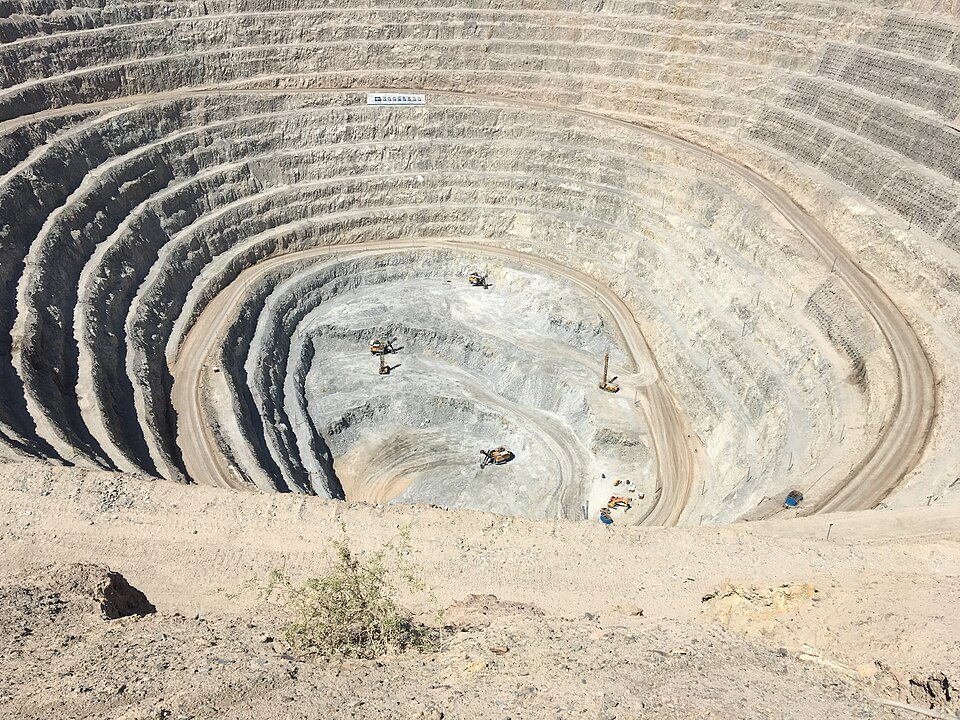
QUETTA: More than two decades after a Chinese company began operating Balochistan’s Saindak copper-gold project, Pakistan is planning to give the Chagai mining venture a broader future, even as security concerns have emerged as one of the biggest threats to its long-term operations.
A new three-year corporate plan of Saindak Metals Limited (SML), the federal government-owned company that owns the project, lays out plans to move beyond the existing mine through new mineral exploration, recovery of metals from mining waste, a proposed pig-iron facility and development of other mineral areas in Chagai.
The plan covers fiscal years 2026-27 to 2028-29 and provides one of the clearest recent pictures of how Islamabad intends to develop Saindak after years of dependence on the existing Chinese-operated project.
But the ambition comes at a difficult moment.
In July, Pakistan increased security around Saindak after the operator raised concerns about disruptions to supply routes. Saindak Metals subsequently rejected reports that the mine could be forced to shut down, saying operations had continued without interruption.
In August, reports again raised questions over whether worsening insecurity could affect China’s long-term involvement in the project. No Chinese withdrawal has been announced, but the episode has put the security of Balochistan’s mining investments back under scrutiny.
From one mine to a wider mining business
SML’s new corporate plan suggests that the future of Saindak may not depend solely on the existing copper-gold operation.
The company says it wants to diversify through a pig-iron facility, Buzgawana/Zamran manganese exploration, PL83 development, recovery of copper from slag and tailings, and cooperation under an agreement with BMEC.
It also plans research into low-grade ore, tailings recovery and extraction of copper from smelter slag.
Under its timetable, SML plans to move the proposed pig-iron project from approval and procurement toward commissioning over the three-year period. Buzgawana/Zamran exploration is expected to progress from mapping to drilling and a preliminary feasibility study, while PL83 is planned to move from assessment towards implementation.
That would potentially turn Saindak from a single producing mine into the centre of a much broader mineral-development strategy in Chagai.
A mine with 11 years left on its current lease
The existing lease, held by MCC Resources Development Company (MRDL), was extended in 2022 for another 15 years, taking it to October 2037.
Under the arrangement, SML remains the asset owner and lessor, while the Chinese company is responsible for mining, processing, smelting and marketing blister copper.
That means the next decade is particularly important.
SML’s new plan envisages four site-monitoring visits every year and quarterly reconciliation of MRDL’s production and financial reports. The company also intends to strengthen its ability to independently monitor the project.
The plan identifies its dependence on MRDL for production and financial data as a high-impact, high-likelihood risk, proposing stronger independent monitoring and an in-house geochemical laboratory as part of the response.
Security is now officially a business risk
The corporate plan is notable because it does not treat security merely as a law-and-order issue.
SML explicitly lists security risks in Chagai and Balochistan as a high-impact, medium-likelihood risk and says it will coordinate with MRDL, the Frontier Corps and provincial authorities.
That assessment takes on greater significance after July’s disruption to supply routes.
The government said in July that additional security would be provided for Saindak’s installations, workers, logistics and cargo after the company raised security concerns. The operator, however, rejected reports that the mine was facing an imminent shutdown.
The question now is not simply whether Saindak is operating today, but whether Pakistan can maintain the security conditions required for a mine expected to remain strategically important for another decade.

SML expects profits, but its projections are cautious
Despite the risks, the company’s financial projections remain positive.
SML expects revenue of approximately Rs7.98 billion in FY2026-27, followed by Rs7.13 billion annually in each of the next two years. It projects after-tax profits of Rs3.77 billion, Rs3.23 billion and Rs3.23 billion respectively.
The projections are based on a 2026 production plan assuming 25,500 tonnes of blister copper, a copper price of $9,200 per tonne and gold at $3,000 per ounce. The document notes that copper prices were above $13,000 per tonne in mid-2026, meaning actual performance could exceed the base-case projections.
But SML also makes clear that its forecasts could change because of security conditions, MRDL’s production plans, commodity prices, government approvals and other unforeseen factors.
Balochistan’s share remains a key question
The plan also highlights the financial importance of Saindak for Balochistan.
SML’s historical figures show that the Government of Balochistan’s share was Rs3.89 billion in FY2025, compared with Rs973 million in FY2024. SML’s total income rose to Rs13.66 billion in FY2025, while its profit after tax reached Rs8.48 billion.
The document further states that under the 2022 lease arrangement, SML is required to channel 6.5% of net profit plus Rs10 million annually to the Government of Balochistan for community uplift in Chagai.
That raises a question that remains important for the future of the project:
Will the expansion of mining in Chagai translate into a proportionate improvement in the lives of people living around the mines?
SML says its mission includes attracting investors while improving the lives of the local population.
The environmental question is moving to the centre
SML’s new plan also acknowledges environmental risks that could become increasingly important as mining expands.
It identifies tailings, emissions and water as a high-impact environmental risk and proposes monitoring of the tailings dam, independent site inspections and research into redesigning the smelter chimney.
The company also plans to adopt an ESG framework and publish its first sustainability report during the three-year period.
For Chagai communities, however, the important issue will be whether these commitments translate into measurable improvements in water management, waste disposal, air quality and mine-site rehabilitation.
A different Saindak by 2029?
SML’s corporate plan suggests that by 2029 it wants to be more than the government company overseeing a Chinese-operated copper mine.
It wants to be an organisation capable of developing new mineral resources, attracting investors, recovering value from mining waste, expanding exploration and building its own technical and monitoring capacity.
But the success of that vision will depend on three unresolved questions.
Can Pakistan keep Saindak secure enough for uninterrupted mining and investment?
Can SML develop new mineral projects while independently monitoring the existing Chinese operation?
And perhaps most importantly for Balochistan:
Can the next phase of mineral development deliver greater economic and environmental benefits to the communities of Chagai?
For now, Saindak’s future is not a story about a mine approaching its end. The government’s own three-year plan points in the opposite direction, toward exploration, diversification and a much larger mining footprint.
The real test will be whether that expansion can survive the security, environmental and governance challenges that the company itself now identifies as risks.
The Saindak Copper-Gold Project, located about 35 kilometres from the Pakistani border town of Taftan and 325 kilometres from Dalbandin, was discovered by the Geological Survey of Pakistan in 1961. The deposits were further studied between 1972 and 1973, when three mineralized zones, the East, North and South ore bodies were identified. Between 1974 and 1977, the Resource Development Corporation, later renamed Saindak Metals Limited (SML), conducted further exploration by drilling 135 boreholes across the targeted areas.
