


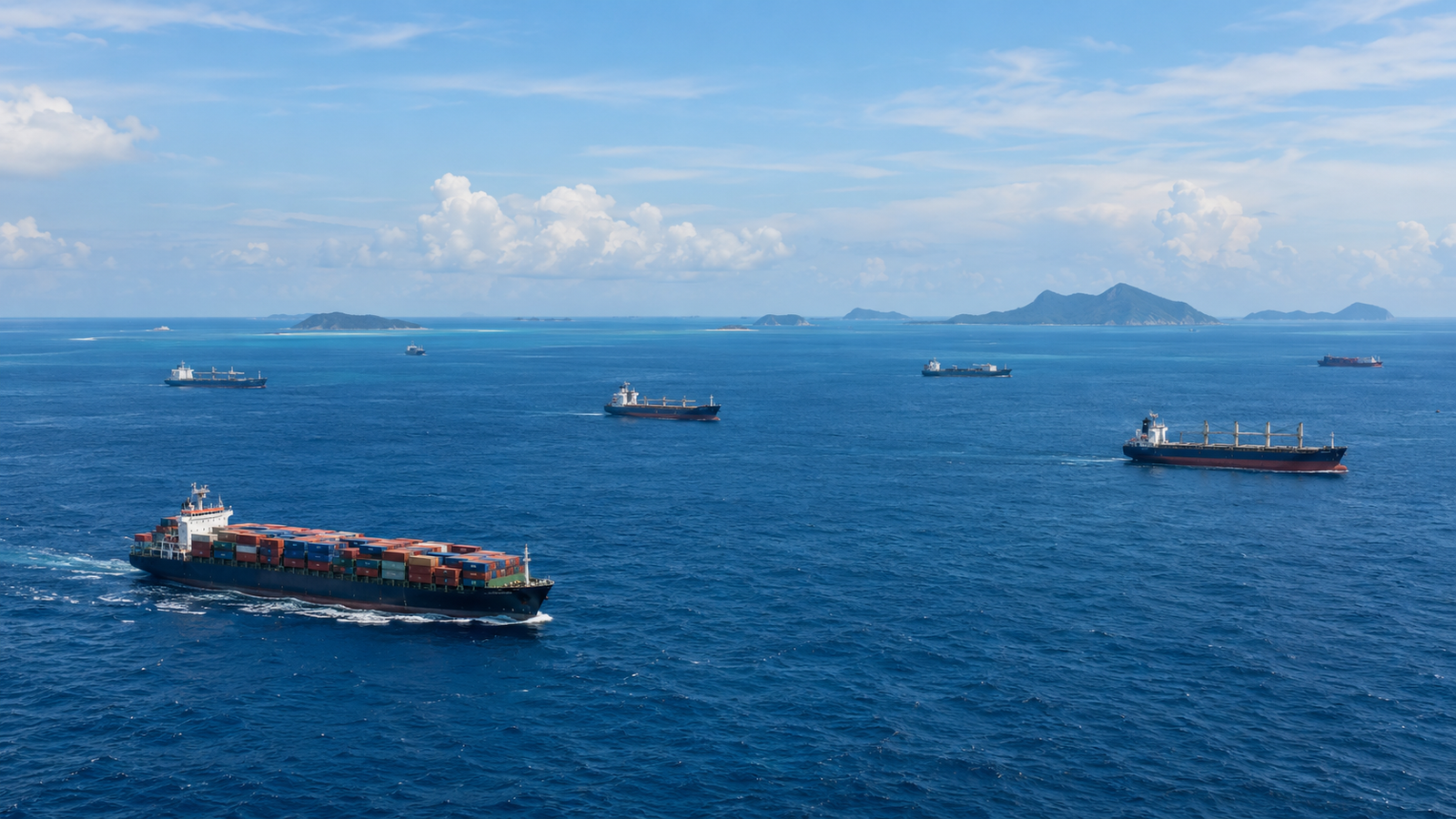
The South China Sea is often described through maps: competing lines, disputed islands, reefs, patrol routes and naval vessels moving through contested waters. But beneath those lines lies a much bigger question, one that reaches far beyond the countries bordering the sea: who decides the rules when powerful states disagree, and what happens when those rules are tested at sea?
For millions of people across Asia, the answer is not an abstract question of international law. The South China Sea is a major shipping route, a source of fish and offshore resources, and an essential part of the region’s economic life. The Permanent Court of Arbitration’s record of the 2016 South China Sea arbitration describes the waterway as a crucial shipping lane, an important fishing ground and a region with substantial oil and gas potential.
That combination of economic importance and unresolved political claims has made the South China Sea one of the most sensitive maritime spaces in the world. China, the Philippines, Vietnam, Malaysia and Brunei have overlapping claims in different parts of the sea, while Indonesia has also faced tensions concerning China’s maritime claims in waters around the Natuna Islands. Taiwan maintains its own claims as well.
Yet the most consequential contest may not ultimately be over who controls a particular reef or island. It may be over whether Asian countries can maintain a predictable maritime order while major powers compete for influence.
At the heart of that order is the United Nations Convention on the Law of the Sea, or UNCLOS, the international legal framework governing the use of the world’s oceans. The convention establishes rules concerning maritime zones, navigation, resources and dispute settlement. The 2016 arbitration between the Philippines and China was brought under UNCLOS and examined questions concerning maritime entitlements, the status of geographic features and the lawfulness of certain actions in the South China Sea.
But the existence of rules does not automatically guarantee compliance.
That is where the South China Sea’s central dilemma begins.
The Philippines initiated arbitration proceedings against China in 2013 under Annex VII of UNCLOS. China did not participate in the proceedings and maintained that it did not accept the arbitration. The tribunal issued its final award in July 2016. The case became one of the most important legal episodes in the modern history of maritime disputes, but it did not end the political or strategic disagreement between the two countries.
Instead, the sea continued to become a place where legal arguments, coast guard operations, fishing activity, military deployments and diplomatic pressure intersect.
For smaller and middle-sized countries in Southeast Asia, this creates an uncomfortable reality. They must protect their maritime interests while avoiding a confrontation that could damage their economies or pull them into a conflict between larger powers.
The Philippines provides perhaps the clearest example. Manila has strengthened its security relationships with the United States and other partners while continuing to pursue its own maritime claims. China, meanwhile, remains one of the Philippines’ most important economic partners.
That dual reality illustrates the difficulty facing many countries in the region: economic interdependence does not necessarily eliminate strategic rivalry.
Recent developments have shown how quickly maritime disagreements can become part of a much larger geopolitical contest. Philippine Defence Secretary Gilberto Teodoro recently warned that changes in the regional military balance could create opportunities for China to expand its influence, while the Philippines has continued strengthening defence cooperation with the United States and other countries.
But if the South China Sea is viewed only through the China-US rivalry, an important part of the story disappears.
The countries that live around the sea are not simply pieces on a strategic chessboard. Vietnam has its own interests. Malaysia has its own interests. Indonesia has its own interests. The Philippines has its own interests. Brunei has its own interests. And ASEAN as an institution has spent years trying to preserve space for dialogue among countries that do not always agree.
That regional diplomacy may be one of the most important, but least dramatic, forces shaping the future of the South China Sea.
ASEAN and China adopted the Declaration on the Conduct of Parties in the South China Sea in 2002. The declaration reaffirmed principles including peaceful dispute settlement, freedom of navigation and overflight, self-restraint and respect for international law, including UNCLOS. It also identified possible areas of cooperation such as marine environmental protection, scientific research, navigation safety, search and rescue and combating transnational crime.
More than two decades later, the fundamental challenge remains: how can those principles be converted into mechanisms capable of preventing incidents from escalating?
The answer being pursued by ASEAN and China is the long-discussed Code of Conduct in the South China Sea.
Negotiations on the Code of Conduct began in 2018, and ASEAN says the parties remain committed to an effective and substantive agreement. In January and May 2026, ASEAN and China held senior officials’ meetings focused on implementing the existing Declaration on the Conduct of Parties and advancing negotiations toward a Code of Conduct.
The negotiations matter because the South China Sea is not simply a dispute that can be solved by drawing a line on a map.
There will always be competing national interests. There will be disagreements over fishing grounds, energy resources, maritime jurisdiction and strategic access. The practical question is whether those disagreements can be managed without producing a cycle of confrontation.
A meaningful Code of Conduct could help establish expectations about behaviour, communication and crisis management. But its effectiveness would depend on whether it is sufficiently clear, substantive and acceptable to the countries involved.
That is a difficult task.
A rule that is too weak may have little effect. A rule that is too restrictive may be politically difficult for states to accept. And a rule that does not adequately address the behaviour of all relevant actors could leave gaps large enough for future disputes to pass through.
This is why the South China Sea may offer a broader lesson for Asia: regional stability cannot depend exclusively on the strength of military deterrence. It also requires mechanisms that reduce the chance of accidents, misunderstandings and confrontations becoming crises.
At sea, the margin for error can be small.
A collision between vessels, a confrontation involving coast guards, an encounter between military aircraft or a dispute over fishing activity can quickly become a national political issue. Once images circulate publicly and nationalist sentiment rises, governments may have less room to compromise.
The sea therefore needs communication channels as much as it needs patrols.
The existing Code for Unplanned Encounters at Sea, for example, reflects an effort to reduce the risk of dangerous encounters between naval vessels. ASEAN and China have previously reaffirmed the importance of applying such mechanisms alongside broader commitments to freedom of navigation and overflight.
But maritime security is also about what happens outside military encounters.
Fishermen are among the people most directly affected by competing claims and increased maritime enforcement. For a fishing community, a disputed maritime boundary is not simply a line on a diplomatic map. It can determine where a boat can operate, whether a crew feels safe at sea and whether a family can earn enough to survive.
The same is true for commercial shipping.
The South China Sea carries enormous volumes of international trade and energy. Any prolonged deterioration in security would potentially affect shipping costs, insurance, supply chains and the wider Asian economy.
That is why freedom of navigation has become such a central phrase in discussions about the region.
Yet freedom of navigation itself is interpreted through different legal and strategic perspectives. Major powers may disagree over the rights and responsibilities associated with military activities in maritime zones, while coastal states may emphasise their jurisdiction and security concerns.
These disagreements demonstrate why maritime law cannot be treated as a technical subject reserved for lawyers.
It is directly connected to security.
It is connected to trade.
It is connected to fishing.
It is connected to energy.
And increasingly, it is connected to the lives of ordinary coastal communities.
There is also an environmental dimension that deserves far more attention.
The South China Sea contains highly productive fisheries and diverse marine ecosystems. Intensifying competition over resources can place additional pressure on an environment already affected by overfishing, pollution, coastal development and climate change.
Marine environmental protection is already identified by ASEAN as an area where practical cooperation can take place despite broader territorial disagreements.
That could offer one of the most realistic pathways toward building trust.
Countries that cannot agree on sovereignty may still be able to cooperate on preventing marine pollution.
They may disagree over territorial claims but cooperate on search and rescue.
They may compete strategically but share information about maritime accidents.
They may have different views of international politics but recognise that depleted fish stocks threaten everyone.
In other words, cooperation does not necessarily require countries to resolve every disagreement first.
Sometimes cooperation can be used to create the trust needed to eventually manage those disagreements.
This is where ASEAN’s role becomes particularly significant.
ASEAN does not possess the military power of China or the United States. It cannot impose a settlement on the major powers. Its strength lies elsewhere: dialogue, consensus-building and the ability to keep competing countries talking.
That approach can appear slow, particularly during moments of confrontation.
But slow diplomacy may be preferable to fast escalation.
For smaller states, the value of ASEAN is partly its ability to prevent the region’s security architecture from being defined entirely by competition between major powers.
The 2026 ASEAN Leaders’ Declaration on Maritime Cooperation reaffirmed the bloc’s commitment to peace, stability and prosperity and to the peaceful resolution of disputes in accordance with international law, including UNCLOS.
That language may sound diplomatic and familiar.
But in an increasingly competitive Indo-Pacific, maintaining such a commitment may itself become a strategic achievement.
The challenge is that international law has limits when political interests diverge.
The 2016 arbitration demonstrates both the possibilities and limitations of legal mechanisms. The tribunal produced a detailed legal ruling under UNCLOS, but the ruling did not by itself resolve the broader political dispute. China has continued to reject the award and has maintained its own position on the South China Sea.
This raises an uncomfortable question for advocates of a rules-based maritime order: what happens when a state rejects the interpretation of an international legal process?
There is no simple answer.
International law relies not only on courts and treaties but also on state practice, diplomacy, reputation and political incentives. A legal ruling may clarify rights and obligations, but preventing conflict ultimately requires states to calculate that cooperation is preferable to confrontation.
That calculation becomes more difficult when maritime disputes are linked to national identity and strategic competition.
This is why the future of the South China Sea may depend less on finding a single grand solution and more on creating layers of protection against escalation.
A strong legal framework can provide one layer.
Diplomatic dialogue can provide another.
A functioning Code of Conduct can provide another.
Hotlines and military communication mechanisms can reduce the risk of accidents.
Joint search-and-rescue exercises can build practical cooperation.
Scientific research can create areas of shared interest.
Environmental agreements can protect resources that no single country can preserve alone.
And stronger regional institutions can provide channels through which disputes can be discussed before they become crises.
For countries outside Southeast Asia, the outcome matters as well.
Pakistan, for example, is not a claimant in the South China Sea, but it is a maritime state with growing economic and strategic connections to China and the wider Indo-Pacific. Its interests include secure shipping routes, freedom of commerce, energy security and a stable maritime environment.
Other countries across South Asia and the Indian Ocean face similar questions.
The South China Sea therefore provides a wider test of whether Asian countries can manage competition without allowing rivalry to destroy the economic connections that have helped drive the region’s growth.
There is an irony at the centre of the debate.
The same sea that brings countries together through trade can also become a source of division.
The same waters that carry energy and goods can become the stage for military confrontation.
The same international law intended to reduce disputes can become part of the dispute itself.
And the same regional institutions designed to build consensus can be tested by the very disagreements they are expected to manage.
That is why the most important question may not be who owns which reef.
It may be whether countries can learn to compete without making cooperation impossible.
A peaceful South China Sea does not necessarily require the disappearance of strategic competition. Major powers will continue to compete. Coastal states will continue to defend their interests. Fishing communities will continue to seek access to marine resources. Governments will continue to interpret maritime law according to their national interests.
Peace requires something more practical.
It requires that competition be placed inside boundaries that states are willing to respect.
It requires communication when vessels meet unexpectedly.
It requires restraint when political pressure encourages confrontation.
It requires legal mechanisms when diplomatic negotiations fail.
And it requires regional cooperation even when sovereignty disputes remain unresolved.
The South China Sea is therefore more than a dispute over islands and maritime boundaries. It is a test of whether a rapidly changing Asia can build a system in which power and law coexist.
The answer will not come from one court ruling, one summit or one military deployment.
It will emerge gradually through the choices made by governments, diplomats, naval and coast guard commanders, fishermen, shipping companies, lawyers and regional institutions.
For ASEAN, the challenge is to keep diplomacy alive while negotiations continue.
For the claimant states, the challenge is to defend national interests without allowing individual incidents to become wider confrontations.
For China and the United States, the challenge is to manage strategic competition without turning the South China Sea into a permanent arena of confrontation.
And for countries such as Pakistan, the challenge is to recognise that maritime security is no longer a distant issue confined to Southeast Asia.
The South China Sea may be thousands of kilometres from Pakistan’s shores, but its stability is connected to the same maritime system on which Asian trade, energy and economic growth depend.
The sea may belong geographically to Southeast Asia.
But its future belongs to a much larger Asia.
And perhaps the ultimate measure of a rules-based maritime order will not be whether countries stop disagreeing.
It will be whether, when they disagree, the rules are strong enough to keep the disagreement from becoming a crisis.
