


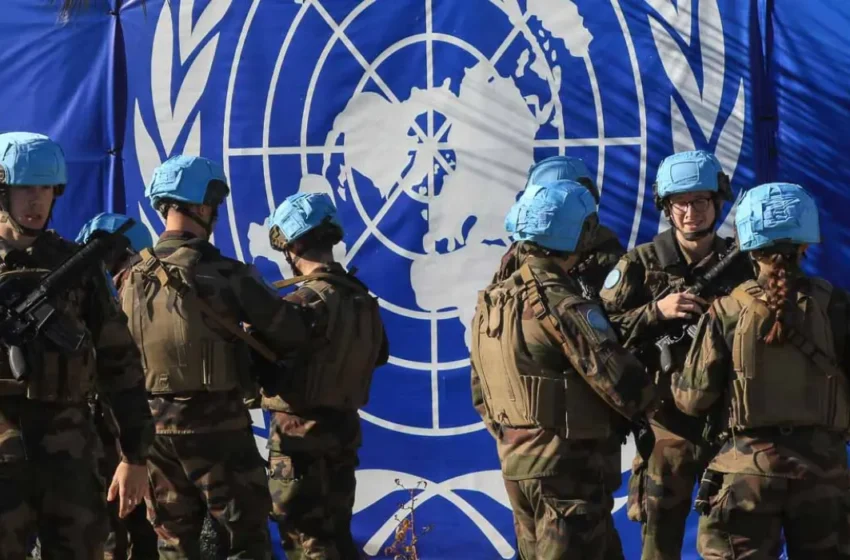
The United Nations has called for a major rethink of its peace operations, warning that the international security environment has changed faster than the organisation’s traditional peacekeeping models.
In his first comprehensive review of the future of all forms of United Nations peace operations, Secretary-General António Guterres has urged member states to make peace operations more political, flexible and focused, while strengthening partnerships with host countries and regional organisations.
The review, contained in S/2026/600 and A/80/798, was submitted to the Security Council and General Assembly in July 2026 following a request made by member states in the Pact for the Future, adopted at the Summit of the Future in September 2024. The review was jointly led by the UN Department of Peace Operations and the Department of Political and Peacebuilding Affairs.
The report comes at a time when the UN says the world is experiencing the highest number of conflicts since 1945. The President of the 80th session of the General Assembly, Annalena Baerbock, said on August 26 that the previous five years alone had produced more conflict-related deaths than the entire 20-year period before 2021.
At the same time, the UN’s peacekeeping system is facing shrinking resources, declining political support and increasingly difficult operating environments.
More than 50,000 military, police and civilian personnel are currently serving in 11 UN peacekeeping missions, with 118 countries contributing uniformed personnel. UN data also show that more than two million people have served under the UN flag since 1948 and that 71 peacekeeping missions have been deployed over the organisation’s history.
The UN’s peacekeeping model developed largely around conflicts in which the parties had agreed to stop fighting and accepted an international presence to monitor ceasefires or support political settlements.
But the nature of conflict has changed. Guterres told the General Assembly that today’s conflicts are increasingly protracted, fragmented and internationalised. He pointed to the growing military use of drones, the possibility of autonomous lethal weapons powered by artificial intelligence, transnational criminal networks, the spread of advanced weapons to state and non-state actors, attacks on civilians and civilian infrastructure, and the renewed threat posed by nuclear weapons.
At the same time, comprehensive peace agreements have become less common. “For the past three decades, our missions were deployed primarily to support conflict parties in reaching and implementing a comprehensive peace agreement after a civil war,” Guterres said. Such agreements, he added, are now increasingly rare, more difficult to achieve and more fragile.
This creates a fundamental problem for traditional peacekeeping: missions are increasingly being asked to operate in environments where there is no comprehensive peace to preserve. Guterres put the principle bluntly during his presentation of the review: “We cannot keep peace when there is no peace to keep.” He said conventional peacekeeping should be deployed when a peace agreement or at least a robust ceasefire exists.
From peacekeeping to a broader peace operations toolbox. The new review does not treat peacekeeping as a single model. Instead, it examines what the UN describes as a continuum of peace operations, including conventional peacekeeping missions, special political missions, regional offices, envoys and other forms of diplomatic engagement.
The spectrum can range from a small office supporting a special envoy to a large multidimensional operation involving military, police and civilian personnel. Guterres cited several examples, including a small political office supporting diplomacy in Sudan, a regional preventive diplomacy office in Central Asia, sanctions panels supporting Security Council sanctions regimes, a joint UN-Organisation for the Prohibition of Chemical Weapons mission dealing with chemical weapons in Syria, and a broadly mandated political mission supporting a political process in Libya.
The review argues that these instruments should not be viewed as separate or competing systems. They can be used at different stages of a conflict and can reinforce one another.
The UN’s peace operations website says the review is based on the understanding that peacekeeping operations and special political missions form an adaptable set of tools that can depend on and reinforce one another.
That approach represents an effort to move away from the assumption that the UN must respond to every crisis with a large, traditional peacekeeping mission.
One of the central messages of the review is that peace operations cannot substitute for political solutions.
Guterres said the problems facing missions are increasingly political rather than simply technical or military. Geopolitical divisions among member states have made it harder to agree on when missions should be deployed, what their mandates should be and how success should be measured.
The result can be missions with broad mandates but insufficient political support or resources. The Secretary-General said peace operations should therefore place a sharper emphasis on peacemaking and conflict prevention.
The review calls for stronger use of diplomacy, mediation and preventive tools before conflicts escalate to the point where a large peace operation becomes necessary. It also encourages fuller use of special political missions and regional offices for preventive diplomacy.
The logic is straightforward, preventing a conflict from escalating may require fewer resources and produce less human suffering than deploying a large operation after violence has already spread.
Another major recommendation concerns the relationship between UN missions and the countries in which they operate. Guterres stressed that peace cannot simply be imported from outside. “Peace cannot be brought in from abroad,” he told the General Assembly. “It must be built from the ground up” through cooperation with host states.
The review therefore proposes stronger and more structured consultations among the Security Council, host governments, troop- and police-contributing countries and the UN Secretariat.
The objective is to establish a shared understanding of what a mission can realistically accomplish throughout its entire life cycle, from deployment to transition and eventual withdrawal. This issue has become particularly important as some recent UN missions have faced restrictions from host governments, disputes over their mandates and, in some cases, demands for their withdrawal.
The Security Council Report noted that several missions have closed at the request of host states, while others have faced restrictions and repeated violations of status-of-forces or status-of-mission agreements.
The review therefore places greater emphasis on partnership, consent and national ownership.
The report also addresses what has long been a problem for UN peacekeeping: missions being given too many responsibilities. The review calls for mandates that are more focused, realistic and adaptable.
Guterres said peace operations should concentrate on areas where the UN has a clear comparative advantage, particularly political and security functions and, where specifically mandated, protection of civilians.
When circumstances change substantially, he said, mandates should also change.
The Secretariat should provide the Security Council with regular assessments of mission performance and proposals for adjusting mandates. Transition and exit strategies should be prepared early and updated as conditions evolve.
The approach echoes concerns raised in previous UN reform reviews about overly broad mandates. The 2015 High-Level Independent Panel on Peace Operations, for example, warned against mandates accumulating numerous tasks without sufficient resources.
The 2026 review essentially brings the issue back into focus: missions should not be expected to accomplish more than their political backing, personnel, equipment and finances allow.
The review also calls for a clearer division of responsibilities between peace operations and the wider UN system.
Peacekeeping missions cannot independently solve problems involving development, governance, humanitarian assistance, human rights and institution-building.
The proposed approach is therefore more networked, with peace operations working alongside UN country teams, development agencies, humanitarian organisations, regional bodies and national institutions.
This could allow a peacekeeping mission to concentrate on political and security responsibilities while other UN entities take the lead on longer-term development and institutional work.
The UN says this is particularly important during mission transitions, when responsibility for functions previously supported by a mission needs to be transferred to national institutions or other UN entities.
The review also places greater emphasis on partnerships with regional and subregional organisations.
Guterres has called for stronger cooperation with regional actors and more effective use of regional peace and security mechanisms.
This is especially significant for Africa, where the African Union and regional organisations have increasingly sought a greater role in responding to conflicts on the continent.
The review’s approach is consistent with the broader UN effort to develop a more structured partnership between the UN and regional organisations, particularly the African Union.
The Security Council has already created a framework through Resolution 2719 for possible UN assessed-contribution financing of African Union-led peace support operations authorised by the Council, although implementation of such arrangements remains a major issue for member states.
The broader principle is that the UN does not necessarily have to provide every soldier itself. Regional organisations may have greater political proximity, local knowledge and willingness to deploy, while the UN can provide political authorisation, legitimacy, financing or other forms of support.
The review also recognises that peacekeepers are operating in an environment increasingly shaped by technology.
Drones and unmanned systems can now be used by armed groups as relatively inexpensive tools for surveillance, attacks and disruption.
The UN’s own 2026 capability assessment says conflicts are increasingly fragmented and influenced by non-state armed groups, transnational criminal networks and actors equipped with new technologies. It identifies digital tools and unmanned systems as increasingly important to situational awareness and force protection.
Guterres also highlighted the emerging risks associated with artificial intelligence and autonomous weapons.
The challenge is not limited to military technology.
Peace operations are also confronting disinformation and misinformation campaigns that can undermine trust between missions and local populations.
The review therefore points towards greater technological readiness, improved information capabilities, stronger situational awareness and better protection against emerging threats.
The UN’s ambitions are also colliding with a financial crisis.
Peacekeeping has traditionally depended on assessed contributions from member states, but delays and shortfalls in payments have created a serious liquidity problem.
In May 2026, UN budget officials told member states that the proposed peacekeeping budget for 2026/27 was about $5.2 billion, a decrease of $425.6 million, or 7.5 per cent, compared with the previous period. Excluding a specific UN support mission adjustment, the proposed reduction was 10.4 per cent, or $557.8 million.
The UN Controller later said member states approved a peacekeeping budget of about $5.1 billion, roughly $550 million less than the previous year, representing a reduction of about 9.7 per cent. Around 1,100 civilian posts were also expected to be reduced.
The financial pressure comes while missions are facing more complicated security environments.
The UN said in June that more than 50,000 civilian, military and police personnel were serving in 11 peacekeeping missions despite significant reductions in political support and resources.
The review therefore links reform with financial discipline.
The Secretary-General has called for greater cost-efficiency, accountability and a sharper focus on results rather than simply maintaining existing structures.
Behind the institutional debate are the risks faced by UN personnel. Guterres said in May 2026 that nearly 4,500 UN peacekeepers had lost their lives since 1948, including 59 in the previous year.
The dangers remain immediate. Just days before the General Assembly discussion of the review, two Ethiopian peacekeepers serving with the UN mission in South Sudan were killed in an attack on a patrol, according to the UN General Assembly President.
The attack illustrated one of the contradictions at the heart of modern peacekeeping: missions are being asked to protect civilians and operate in increasingly dangerous environments at the same time as their personnel and resources are being reduced.
A record of what peace operations can achieve Despite its criticism of current challenges, the UN review does not portray peace operations as obsolete.
The Secretary-General pointed to missions that helped countries move from war towards peace. UN operations supported the first democratic elections after civil wars in Mozambique and Cambodia, helped disarm child soldiers in Sierra Leone and supported Namibia’s transition to independence.
Guterres also cited the UN’s role in the Cameroon-Nigeria border dispute. The organisation first used diplomatic efforts to help the two countries accept and implement the International Court of Justice ruling and later deployed a special political mission that helped demarcate the boundary.
These examples underpin one of the review’s central arguments: the future of UN peace operations should not be defined only by the traditional blue-helmet model. Diplomacy, mediation, political missions, regional partnerships, peacekeeping and peacebuilding can all form part of a broader system.
The future of peace operations also involves questions about who serves in missions and whose perspectives shape peace processes.
UN data show that women remain a minority among uniformed peacekeepers. The UN’s 2025 annual report recorded more than 5,900 women peacekeepers and 1,980 women civilian personnel among its peace operations workforce.
The wider UN peace and security agenda continues to call for the full, equal and meaningful participation of women and young people in political and peace processes.
This is important because peace operations increasingly involve not only military tasks but mediation, political negotiations, community engagement, protection of civilians, human rights and institution-building.
Taken together, the review proposes a shift in how the UN thinks about peace operations. The model of a large, long-term mission with a broad mandate is not being abandoned altogether. Instead, the UN is seeking greater flexibility in deciding what type of intervention is appropriate for a particular crisis.
That could mean a diplomatic envoy rather than a military mission. It could mean a regional political office rather than a large field operation. It could mean a peacekeeping force to monitor a ceasefire, followed by a political mission and then a UN country-team-led transition. Or it could involve a regional organisation taking a larger operational role with UN political or financial support.
The review therefore treats peace operations as a continuum rather than a single instrument. The most difficult part may not be agreeing on the diagnosis.
The UN has conducted major peacekeeping reviews before, including the Brahimi Report in 2000 and the High-Level Independent Panel on Peace Operations in 2015. Successive reforms have called for clearer mandates, stronger partnerships, better coordination, adaptable administrative systems and greater cooperation with host countries and regional organisations.
The UN itself acknowledges that many earlier reforms remain only partly implemented.
