


QUETTA: A major investigation into the alleged theft of government-owned weapons in Balochistan has revealed concerns that arms and ammunition may have been diverted from official stockpiles and sold to banned organizations, according to police sources and case documents.
Three people, including former Levies personnel and a serving police officer, have been arrested in connection with the case. The arrests, which took place several months ago, were not publicly disclosed at the time.
The case came to light in May 2026 when the Excise Department recovered weapons from a vehicle during routine checking in the Baleli area of Quetta. The matter was subsequently handed over to the Counter-Terrorism Department (CTD) for further investigation.
According to sources, CTD investigators later recovered a large quantity of weapons and ammunition from a house in Killi Nohesar, Quetta, and arrested two suspects.
One of the suspects, identified as Roshan Khan, had been posted at a Levies arms depot. Investigators subsequently arrested Abdul Hakim, who had served as an officer in the Levies force and was later serving as a deputy superintendent of police (DSP), for questioning in connection with the investigation.
A case, registered as FIR No. 71/2026 on May 18, 2026, was filed on the complaint of Sub-Inspector Shaista Khan. The FIR includes provisions of the Explosive Substances Act, Balochistan Arms Act and Anti-Terrorism Act.
Large cache of weapons recovered
According to the FIR, CTD received information from a confidential source that Roshan Khan, a Levies employee, was allegedly supplying weapons and explosives to banned organizations for terrorist activities along with associates identified as Muhammad Shafiq and Hanif Barich.
Acting on the information, a CTD team raided Roshan Khan’s residence in Killi Nohesar. Roshan Khan and Muhammad Shafiq were arrested, while Hanif Barich allegedly escaped by jumping over a wall.
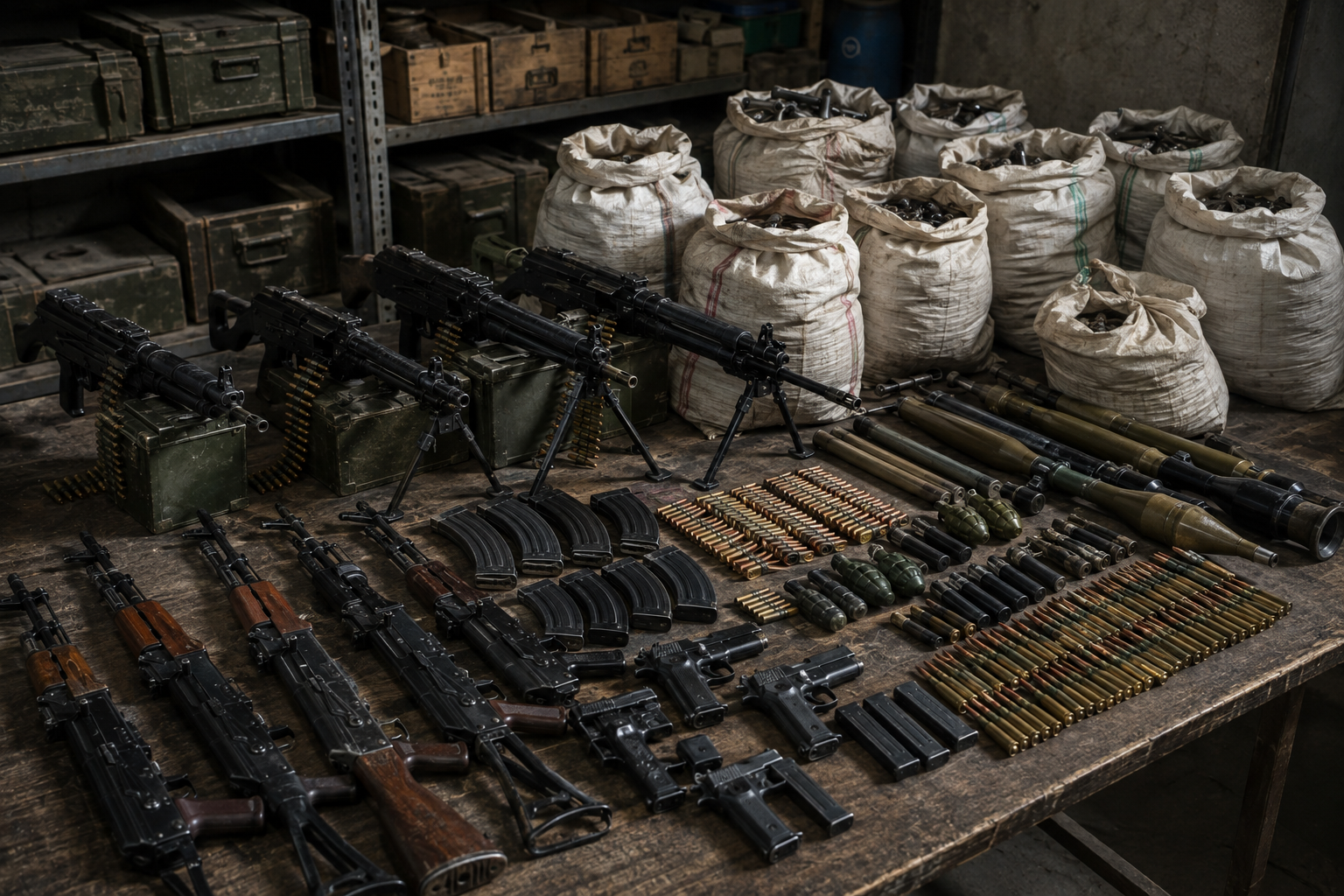
Investigators reportedly recovered two 9mm pistols from the suspects. A subsequent search of the house led to the recovery of a substantial quantity of weapons and ammunition stored in eight sacks and a wooden box.
The recovered weapons reportedly included four submachine guns, six Chinese-made rifles, three light machine guns, five .303 rifles, one G3 rifle and two rifles of 12- and 22-bore calibers.
More than 5,000 rounds of ammunition and dozens of magazines were also recovered.
The cache further included 16 rocket-propelled grenades, two launchers, 18 fuses and 10 hand grenades. According to the FIR, two hand grenades and 18 fuses were declared dangerous and destroyed at the scene, while the remaining weapons and ammunition were taken into official custody for legal proceedings.
Alleged diversion of government weapons
According to a police officer familiar with the investigation, investigators believe that government employees allegedly removed weapons from official premises using government vehicles and transported them to different areas, including Quetta, Pishin and border regions of Qila Abdullah and Gulistan, where they were allegedly sold.
The officer said the investigation also indicated that weapons were allegedly being offered for sale through WhatsApp without properly verifying the identity of buyers.
This has raised concerns that weapons from government stocks may have reached members or affiliates of banned organizations, although the alleged sales and identities of any such buyers remain subject to investigation.
The police officer said mobile phone numbers believed to belong to individuals who purchased weapons had reportedly been switched off following the arrests.
Former Levies official dismissed
Abdul Hakim, a former Levies official and serving DSP, was dismissed from government service, according to a statement issued by the police spokesperson’s office on August 19.
The statement said Abdul Hakim was dismissed for prolonged absence from duty, serious misconduct and failure to respond to official show-cause notices.
However, questions surrounding the institutional responsibility for the alleged missing weapons remain part of the wider investigation.
A police officer said the Directorate General Levies had previously reported other incidents involving the alleged disappearance of government weapons, equipment and machinery.
According to the officer, several such incidents allegedly occurred during the process of merging the nearly 150-year-old Levies Force into the Balochistan Police and transferring its assets.
Investigation faces record-keeping challenges
The investigation into the alleged theft of additional equipment and weapons is continuing. However, police sources said CTD investigators have faced difficulties because of alleged pressure and a lack of cooperation from some officials.
Former Levies officials have yet to provide complete records of weapons and other government equipment, according to the sources.
A police officer said the lack of properly maintained records, stock registers and vehicle logbooks had complicated efforts to determine the quantity of weapons and equipment allegedly missing from government custody.
The officer also suggested that other government agencies responsible for investigating corruption and financial irregularities should be involved in the inquiry.
There are also concerns that items seized in criminal cases, anti-riot equipment and bulletproof jackets may be among the government property that could be missing, the officer said.
The case challan has reportedly not yet been submitted to the court, despite several months having passed since the investigation began.
Former Levies officials dispute responsibility
A former senior Balochistan Levies official, speaking on condition of anonymity, shared a written statement disputing some aspects of the allegations. The statement was also published on a Facebook page associated with the Balochistan Levies Directorate.
According to the statement, the Levies Force had already been fully merged into the Balochistan Police under a February 3, 2026 notification issued by the Balochistan Home Department. Its assets and responsibilities had consequently been transferred to the police.
The statement maintained that although the two arrested officials had previously served in the Levies Force, they were formally employees of the Balochistan Police at the time of their arrests because the merger had already been completed.
It said both suspects were in jail and that their roles were still being investigated.
The former official also disputed the characterization of the former Levies Directorate building as an active Levies office. According to the statement, the building had been allocated to the Home Department after the merger and was subsequently used as the office of the provincial home minister.
The statement further said that, under a Finance Department document dated April 22, 2026, the transfer of 12 cadre posts from the Levies Directorate to the Services and General Administration Department had been approved.
It argued that responsibility for any financial or weapons-related irregularities should be determined on the basis of the institutional structure in place at the time of the alleged incidents and the findings of the ongoing investigation, rather than solely on the basis of the officials’ previous employment with the Levies.
Calls for audit of weapons and assets
The former Levies official said any claims concerning missing weapons or government equipment should be verified by comparing records from official stores, arms registers, asset inventories and documents relating to the transfer of property to the police.
The statement said the roles of both arrested officials were also being examined as part of the ongoing investigation.
The allegations have raised broader questions about the management, documentation and transfer of government weapons and other sensitive equipment during the merger of the Levies Force with the Balochistan Police.
The CTD investigation is continuing, and the alleged sale of government weapons to banned organizations has not yet been established by a court. Further findings, including the complete inventory of missing weapons and equipment and the identities of alleged buyers, are expected to emerge as the investigation progresses
