


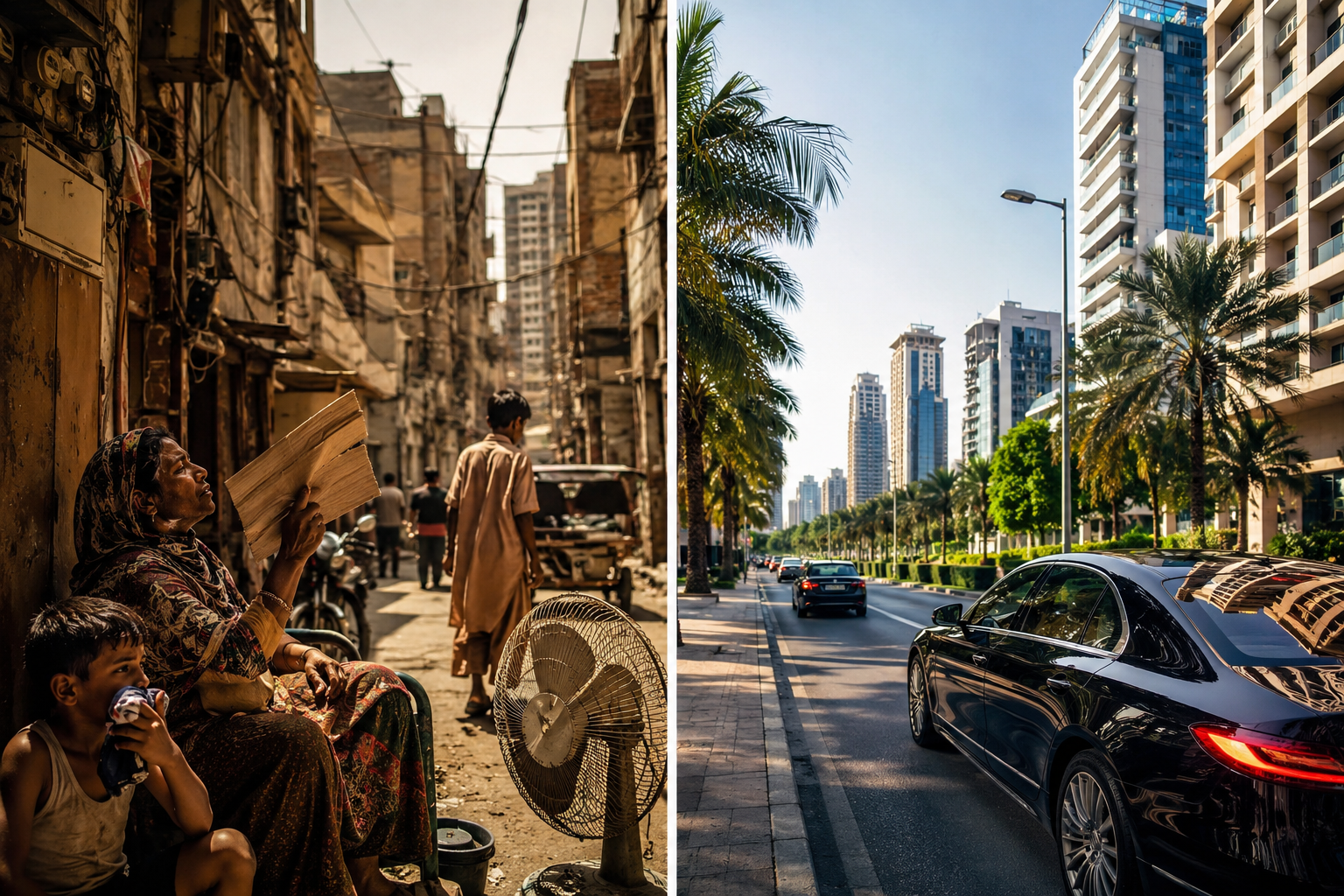
In the first week of May, Karachi is already struggling with rising heat. The sun feels harsher than it should for early summer, and people who spend time outdoors are beginning to adjust their routines. The worst of the season has not yet arrived, but the signs of what is coming are already visible in how daily life is changing.
In Lyari, one of Karachi’s most densely populated low income neighborhoods, afternoons are becoming difficult to manage. Concrete homes absorb heat throughout the day and release it slowly into small, poorly ventilated rooms. Inside one house, a ceiling fan turns slowly as electricity cuts interrupt any sense of relief. A mother sits beside her children and uses a piece of cardboard to move air in the room. She explains that the day feels longer now and that even May has started to feel like peak summer used to feel in the past.
A short drive away in DHA, the situation is very different. Air conditioners run steadily in homes designed to keep heat outside. Curtains remain drawn during the day and most activity happens indoors. For residents here, the heat is noticeable but manageable, and it rarely disrupts daily routines. The same city is already splitting into two different experiences of summer even before temperatures reach their highest point.
This early contrast is becoming more visible across Pakistan. Heat is arriving earlier each year, and its impact is not equal. It is shaped by income, housing conditions, access to electricity, and the ability to avoid exposure during the hottest hours of the day.
Pakistan is among the countries most affected by climate change. Over the past three decades, temperature patterns have shifted, with summers starting earlier and lasting longer in many parts of the country. The Pakistan Meteorological Department has reported that average temperatures in southern regions have steadily increased, and extreme heat events are becoming more frequent.
Even in early May, several cities in Sindh and southern Punjab begin to experience temperatures above 40 degrees Celsius. In some years, heatwaves arrive before the official start of peak summer, placing pressure on electricity systems, water supply, and public health services.
Scientists warn that this early heat is part of a broader warming trend in South Asia, where climate change is increasing both the intensity and duration of heatwaves. What used to be extreme conditions for June or July is now appearing in May.
But the impact of this shift is not evenly shared across society.
In cities like Karachi, Lahore, and Multan, heat is experienced differently depending on where people live. Research on urban heat patterns shows that densely populated neighborhoods with limited green space can be several degrees hotter than wealthier areas within the same city.
In low income settlements, homes are often built close together without proper ventilation. Streets are narrow, tree cover is limited, and concrete structures trap heat throughout the day. As a result, indoor temperatures remain high even after sunset.
In contrast, wealthier neighborhoods benefit from wider roads, more vegetation, and better designed housing that reduces heat absorption. These areas also have more stable electricity supply, which allows continuous use of cooling systems during hot periods.
This creates a situation where two families living in the same city can experience completely different levels of heat stress during the same day.
In Orangi Town in Karachi, residents describe how even May afternoons now require planning around electricity availability. Fans stop working during power cuts, water pumps shut down, and homes become difficult to stay in for long periods. People often wait for evening hours when temperatures drop slightly before resuming normal activities.
In northern Sindh, the city of Jacobabad is already preparing for conditions that are expected to worsen in the coming months. Known for some of the highest recorded temperatures in the world, the city regularly experiences extreme heat during peak summer.
By early May, temperatures in the region already begin to cross uncomfortable levels for outdoor workers. Construction laborers, street vendors, and agricultural workers spend long hours outside, often without adequate shade or cooling.
At the civil hospital in Jacobabad, healthcare workers report that cases of dehydration and heat exhaustion start appearing well before peak summer arrives. Many patients are daily wage earners who cannot reduce their working hours despite rising temperatures.
Doctors say that heat related illnesses often increase gradually from May onwards, reaching critical levels in June and July. The majority of severe cases come from low income communities where people are more exposed to outdoor conditions and have limited access to cooling at home.
Brick kiln workers in surrounding areas are particularly vulnerable. Their work continues in high temperature environments where ovens already produce extreme heat. For them, early summer does not signal preparation time but the beginning of a long period of physical strain.
Outside urban centers, rural communities are already adjusting to early rising temperatures. In southern Punjab districts such as Bahawalpur and Rahim Yar Khan, agricultural work continues despite increasing heat in the fields.
Farm laborers often begin work early in the morning but remain exposed to high temperatures as the day progresses into afternoon. Many report fatigue and dehydration even in May, though work continues because agricultural cycles and income needs do not allow long breaks.
Landowners often remain less exposed during peak heat hours, while laborers carry out physically demanding tasks in open fields. This difference creates an uneven distribution of heat exposure within the same agricultural system.
Local health workers note that heat related symptoms begin appearing earlier each year, but official records remain limited. Pakistan does not have a comprehensive national tracking system for heat related illness, which makes it difficult to measure the full scale of the problem.
In early summer conditions, electricity becomes one of the most important factors in determining how people experience heat.
In low income neighborhoods, power cuts often occur during peak demand hours. When electricity stops, fans shut down, indoor temperatures rise quickly, and water supply systems are affected. Even short outages can create difficult living conditions during hot afternoons.
In wealthier households, backup systems such as generators and solar panels help maintain cooling even during grid instability. Air conditioners continue running and indoor environments remain controlled despite external heat conditions.
This difference means that access to electricity is not just a service issue but a survival factor during heat periods.
Public hospitals in major cities begin to feel the pressure of rising temperatures even in May. Emergency departments report increasing cases of dehydration, heat exhaustion, and complications related to existing health conditions worsened by heat.
In Karachi’s public hospitals, healthcare workers observe that most early heat related patients come from working class communities. Many arrive after spending long hours outdoors or after living in homes without cooling during power cuts.
Private hospitals remain largely out of reach for many families due to cost, which places additional pressure on public healthcare facilities during heat periods.
Doctors also note that heat related illnesses are often underreported because they are recorded under general categories rather than identified as heat specific conditions. This limits understanding of how many people are affected by rising temperatures.
What is already visible in early May is a widening gap in how heat is experienced. The difference is not only about temperature but about infrastructure, income, and access to basic services.
For wealthier households, early summer is manageable through cooling systems and stable electricity. For low income communities, even the early stages of heat season bring significant disruption to daily life.
Climate experts warn that as temperatures continue to rise in South Asia, this divide will become more pronounced. Heatwaves are expected to become more frequent and longer in duration, increasing pressure on already unequal systems.
As May progresses, residents across Pakistan know that conditions will become more difficult in the coming weeks. In neighborhoods like Lyari, people are already adjusting their routines to cope with rising temperatures. Activities are shifted to early morning or late evening hours, and afternoons are spent waiting for cooler air.
In wealthier parts of the city, summer arrives as an inconvenience managed through technology and infrastructure. In poorer areas, it arrives as a test of endurance.
Even before peak summer begins, the difference is clear. Heat does not affect everyone in the same way, and in Pakistan, the ability to survive rising temperatures is increasingly shaped by how much a person earns and where they live.
