


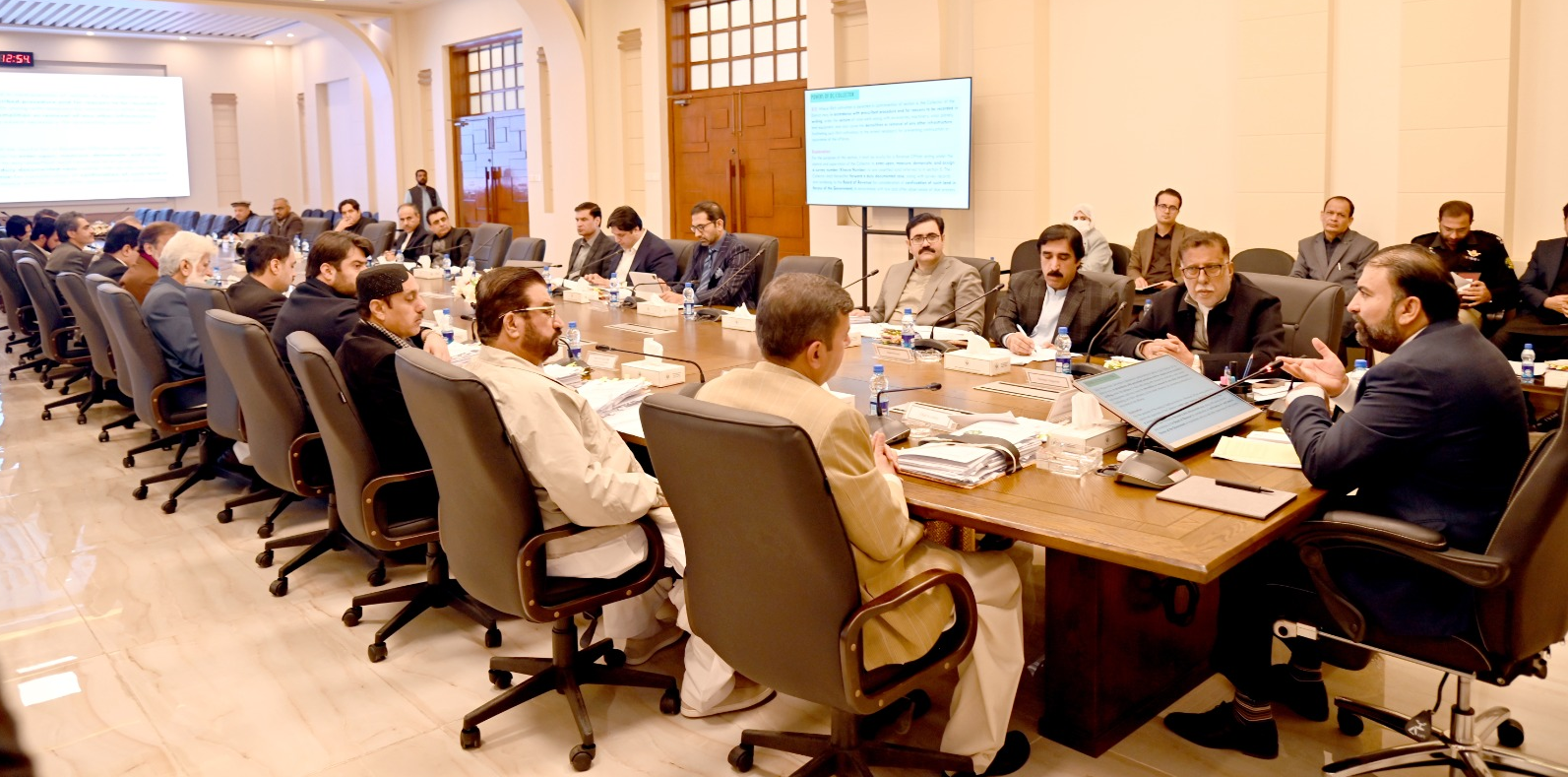
Quetta: The Balochistan Provincial Cabinet, chaired by Chief Minister Mir Sarfraz Bugti, held its 22nd meeting and approved a series of decisions aimed at strengthening governance, addressing the long-standing issue of missing persons, countering extremism, reforming administrative structures, and improving education and social protection mechanisms across the province.
Describing the cabinet’s decisions as historic, Chief Minister Mir Sarfraz Bugti said the provincial government has resolved the issue of missing persons on a permanent and legal basis. He stated that certain elements had long exploited the issue for political gains, but the government has now “buried this propaganda forever” by introducing transparent, lawful, and rights-based mechanisms.
The cabinet approved the Balochistan Prevention of Detention and De-radicalization Rules 2025, under which suspected individuals will only be interrogated at authorized investigation centers under the supervision of empowered police officers. To ensure transparency and human rights protection, family members of suspected individuals will be allowed to meet them during detention.
In another major step, the cabinet approved the Balochistan Center of Excellence on Countering Violent Extremism Rules 2025, aimed at developing research-driven strategies to prevent radicalization and violent extremism in the province. The cabinet also approved the Balochistan Witness Protection (Amendment) Bill 2025, strengthening legal safeguards for complainants and witnesses, particularly in terrorism-related cases.
Chief Minister Bugti emphasized that good governance is only possible through effective enforcement of laws. He assured that the provincial government will pursue court cases on strong legal grounds and ensure complete protection for witnesses and complainants at terrorism-affected sites.
The cabinet expressed satisfaction over merit-based recruitments conducted through online testing in the Finance Department and decided to gradually digitize recruitment processes in all provincial departments to promote transparency, efficiency, and merit.
In a significant administrative reform, the cabinet approved the abolition of the Department of Religious Affairs, with its employees to be adjusted in other departments. The cabinet also approved the creation of two new divisions — Pishin and Koh-e-Suleman, while deciding that Ziarat district will be administratively linked with Loralai. Additionally, the establishment of Municipal Committee Karbala in Pishin district was approved.
Several key policy decisions were also endorsed, including the Law Officers Evaluation Policy, amendments to the Minorities Affairs Grant-in-Aid Policy, and a landmark decision banning forced labor for children under the age of 16, reinforcing the province’s commitment to combating child labor.
The cabinet declared the Higher Technical Education Department as an essential service and ordered verification of academic credentials of all contract-based teachers. The Chief Minister Inspection Team has been tasked with the verification process, with FIRs to be registered against fake degree holders. The verification drive will begin from Nasirabad and Dera Bugti.
In the education sector, the cabinet agreed to incorporate the National Curriculum into the provincial syllabus from the academic year 2026–27. It also approved the launch of the Chief Minister Academic Excellence Program for Quality Teachers Support and decided to recruit ad-hoc teachers for Mathematics, Science, and English in middle, high, and higher secondary schools.
The cabinet also considered the establishment of food streets from Saleem Complex to Imdad Chowk and from Taxi Stand to Liaquat Square, forming a committee to review feasibility.
Chief Minister Mir Sarfraz Bugti termed the approval of these major laws and reforms a significant achievement, reaffirming the government’s commitment to transparency, security, and public welfare in Balochistan.
