


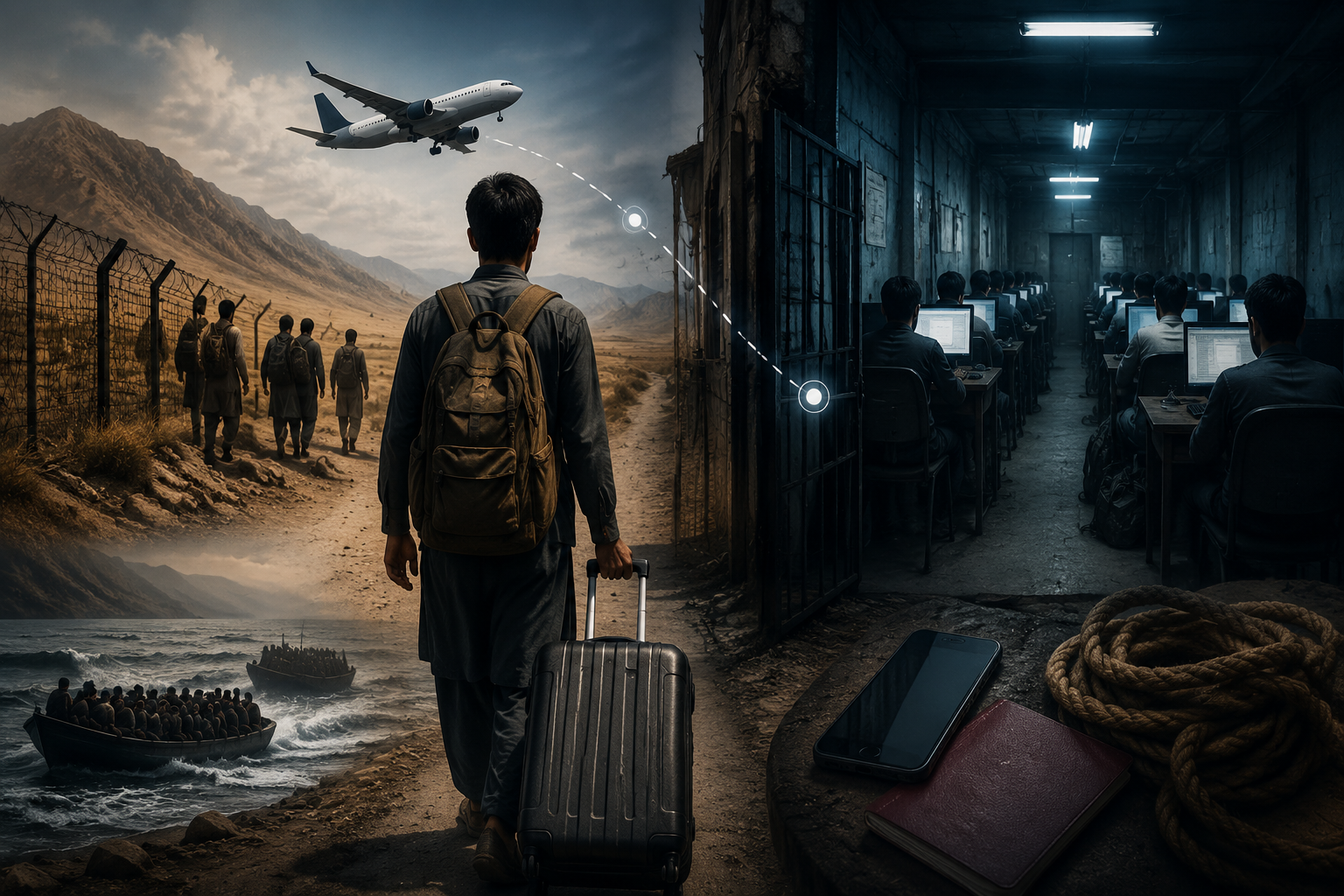
How fake overseas jobs, human smugglers and vulnerable border communities could place Pakistan’s largest province at the centre of an emerging form of human trafficking.
The message seemed simple enough. A well-paid customer service job in Thailand. Free accommodation. A work visa. A salary that could change a family’s future. For thousands of young people across South Asia, these promises have become impossible to ignore. With unemployment rising and legal migration becoming harder, many see overseas jobs as their only chance to escape poverty. But for many, the dream ends behind locked gates.
Across Myanmar, Cambodia and Laos, criminal syndicates have built a multi-billion-dollar industry around online fraud. Their operations depend on a hidden workforce, young men and women recruited from dozens of countries through fake job offers before being forced to run cryptocurrency scams, romance fraud and fake investment schemes.
The International Organization for Migration (IOM) estimates that more than 120,000 people may be trapped in scam compounds in Myanmar alone, while tens of thousands more are believed to be working under coercion in Cambodia and neighbouring countries. Victims have been identified from Pakistan, Bangladesh, India, Nepal, Ethiopia, Kenya, Philippines and many other nations.
Most never imagined they were being trafficked. Instead, they believed they were travelling abroad for legitimate employment.
For decades, human trafficking in Pakistan was often associated with forced labour, sexual exploitation or dangerous sea journeys towards Europe. Today, investigators say the crime is changing. Instead of hiding migrants inside trucks or overcrowded fishing boats, traffickers increasingly operate through smartphones.
Recruiters advertise jobs on Facebook, WhatsApp, Telegram and TikTok. They present themselves as recruitment agents, travel consultants or overseas employers. Some victims are even recruited by friends or relatives who are themselves trapped inside scam compounds and forced to find new workers.
The recruitment process often appears legal. Applicants attend online interviews. They receive offer letters. Air tickets are arranged. Some even obtain valid visas. Only after reaching Southeast Asia do many realise they have entered a different world.
Passports are confiscated. Phones are taken away. Movement is restricted. Armed guards patrol the compounds. Instead of answering customer service calls, victims are ordered to deceive strangers online, often for sixteen hours a day. Survivors have described beatings, electric shocks, starvation and threats of being sold to another criminal group if they fail to meet daily scam targets.
The United Nations describes the industry as one of the fastest-growing forms of transnational organised crime. Where does Pakistan fit? Pakistan is not among the largest source countries for scam trafficking. Yet it is becoming increasingly visible. Over the past two years, Pakistani citizens have been rescued from scam compounds in Myanmar and Cambodia after accepting fake overseas jobs. Their stories closely resemble those of victims from other countries.
Most were not kidnapped from the streets. They travelled willingly. The deception came later. While many cases involve direct flights to countries such as Thailand or Malaysia before victims are moved across land borders into Myanmar, migration experts warn that trafficking networks constantly adapt their methods.
This raises an important question for Pakistan. Could existing human-smuggling networks also become recruitment channels for scam trafficking?
Stretching across nearly half of Pakistan’s landmass, Balochistan shares more than 1,300 kilometres of border with Afghanistan and nearly 900 kilometres with Iran. For decades, these borders have served as major migration corridors. Every year, thousands of people move through official crossings such as Chaman and Taftan, while many others rely on irregular routes controlled by human smugglers.
Some are Afghan refugees. Others are Pakistanis searching for work abroad. Many hope to reach Europe through Iran and Turkiye. This movement has created an extensive underground economy built around migration. Smugglers arrange transport. Forged documents circulate. Middlemen connect migrants with agents across multiple countries.
Federal Investigation Agency (FIA) officials have repeatedly dismantled networks operating in Balochistan. In recent months alone, authorities arrested suspected traffickers in Gwadar for allegedly attempting to send migrants to Iran through illegal sea routes. In separate operations in Taftan and Loralai, FIA officers arrested suspects accused of using fake documents and illegal border crossings to move people towards Iran and Turkiye.
These cases are not directly linked to scam compounds in Southeast Asia. But they reveal something important. The criminal infrastructure that facilitates irregular migration already exists. Whether parts of these networks could also be exploited for scam trafficking remains an unanswered question.
Migration is woven into everyday life across much of Balochistan province of Pakistan. In its border district Chaman, families cross the border for trade, healthcare and work. In Taftan, pilgrims and migrants pass through one of Pakistan’s busiest crossings with Iran.
Along the Makran coast, security agencies have repeatedly intercepted boats carrying migrants attempting dangerous journeys. For many young people, leaving home has become a survival strategy rather than a choice. Years of conflict, drought, inflation and unemployment have left countless families searching for opportunities elsewhere.
This desperation is precisely what trafficking networks exploit. The promise does not have to be extravagant. A salary of US$1,000 a month can seem life-changing in communities where jobs are scarce. Traffickers understand this. Rather than forcing people onto trucks, they persuade them to buy airline tickets.
The dangers of irregular migration are already painfully familiar in Pakistan. Boat disasters in the Mediterranean have claimed the lives of dozens of Pakistanis in recent years. In another recent case, twelve Pakistani youths were kidnapped in Iran after allegedly paying smugglers thousands of dollars to reach Italy. According to the FIA, the traffickers tortured the victims, sent videos to their families and demanded ransom payments.
Investigators say the victims had travelled through Balochistan before entering Iran. The case highlighted how migration itself can become a tool of organised crime. Experts warn that scam trafficking follows the same pattern of deception, although the destination is different.
Instead of ending in Europe, victims disappear into cybercrime compounds thousands of kilometres away in Southeast Asia. The journey begins with hope. It ends in exploitation.
