


Gwadar Port in Pakistan’s southwestern Balochistan province is witnessing a steady rise in commercial shipping activity, reflecting its growing role in regional and international maritime trade at a time of heightened geopolitical uncertainty across key global sea routes.
The deep-sea port, located near the strategic entrance of the Persian Gulf, is gradually emerging as an alternative logistics and transshipment hub as global shipping patterns shift due to regional instability and disruptions in traditional maritime chokepoints.
In recent operations, the special cargo vessel MV H.M.O Leader successfully berthed at Gwadar Port and handled 35 units of transshipment cargo. Officials said the smooth operation reflects improving port efficiency and expanding operational readiness for international shipping lines.
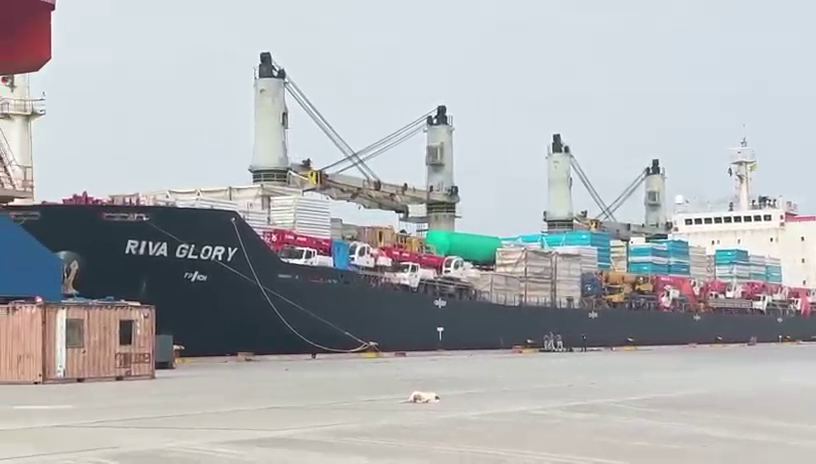
Another major vessel, MV Riva Glory, also arrived at the port carrying 14,629 metric tons of commercial cargo. The unloading process is currently underway according to schedule, indicating increasing vessel traffic and growing commercial confidence in the port.
Authorities confirmed that another cargo ship had arrived last week, while additional vessels are expected in the coming days as shipping activity continues to expand.
Gwadar’s growing activity comes at a time when regional maritime routes, particularly around the Strait of Hormuz and surrounding waters, have faced repeated disruptions due to geopolitical tensions involving Iran and other regional actors.
The Strait of Hormuz, one of the world’s most critical energy and shipping corridors — has experienced intermittent disruptions and heightened security risks amid broader Iran-related tensions and military escalations in the Gulf region. Any instability in this narrow waterway, through which a significant share of global oil and container trade passes, has a direct impact on international shipping costs and route planning.
In this context, shipping companies are increasingly exploring alternative routes and ports to reduce exposure to risk. Gwadar, positioned near key Arabian Sea shipping lanes, is gradually being viewed as a potential fallback and diversification point for cargo movement.
Pakistan’s Federal Minister for Maritime Affairs, Muhammad Junaid Anwar Chaudhry, said Gwadar is emerging as a secure maritime alternative amid regional instability affecting traditional trade corridors. He noted that global shipping firms are reassessing logistics strategies due to geopolitical risks, and Gwadar is being considered as a safer transit and transshipment option.
According to him, the shifting trade environment is not temporary but part of a broader realignment in global maritime supply chains driven by security concerns, insurance costs, and route disruptions.
The minister also highlighted that Gwadar Port offers free storage facilities for transshipment cargo, a key incentive aimed at attracting international operators seeking cost-efficient logistics solutions in a volatile regional environment. These facilities reduce turnaround costs and make the port more competitive compared to other regional hubs such as those in the Gulf region.
Gwadar Port and its Free Zone currently have the capacity to handle around 16,000 TEUs (twenty-foot equivalent units), along with more than 90,000 square meters of storage space for general cargo. Officials say these capabilities are part of a broader effort to transform Gwadar into a modern logistics hub connecting South Asia, the Middle East, and Central Asia.
Gwadar’s geographic location is central to its growing importance. Situated along the Arabian Sea and relatively close to the Strait of Hormuz, the port sits near one of the world’s most sensitive maritime corridors. The Strait of Hormuz is a critical passage for global energy and container shipping, and recent geopolitical tensions involving Iran and Western powers have led to increased concerns about the security of this route.
Industry reports indicate that disruptions, insurance risks, and occasional closures or slowdowns in the Strait have already forced shipping companies to reconsider traditional routes through the Gulf region. In this environment, alternative ports such as Gwadar are gaining attention as potential relief points for cargo diversion and transshipment operations.
Gwadar Port Authority Chairman Noor-ul-Haq Baloch said the rising number of cargo vessels reflects growing international confidence in the port’s operational capabilities. He noted that at least five additional vessels are expected to arrive soon, further increasing maritime traffic at the facility.
According to him, Gwadar’s proximity to key international sea routes and its strategic position near Iran and Central Asia enhance its long-term importance in global trade networks. He added that the port is no longer in a purely developmental phase but is gradually transitioning into active commercial operations.
Alongside port operations, the Gwadar Free Zone is being developed as an industrial and logistics ecosystem designed to support long-term economic activity. Spanning approximately 2,800 acres, the Free Zone is intended to host manufacturing industries, logistics companies, storage facilities, and export-oriented businesses.
Officials confirm that two industries are already operational within the zone, with more expected to become active as infrastructure expands. The Free Zone is expected to play a key role in job creation, particularly in Balochistan, while also attracting both domestic and foreign investment in industrial and logistics sectors.
Experts suggest that such zones are critical in integrating emerging ports into global supply chains, especially in regions with underdeveloped industrial bases.
Economists and maritime analysts view Gwadar’s growing activity as part of a broader shift in global trade dynamics. Recent disruptions in maritime chokepoints, particularly around the Strait of Hormuz and other sensitive Middle Eastern waters influenced by Iran-related tensions have accelerated the search for alternative logistics routes.
At the same time, global shipping companies are facing rising insurance costs, longer transit times, and operational risks in traditional corridors, encouraging diversification of ports and routes.
Within this changing environment, Gwadar is increasingly being positioned as a potential transshipment and redistribution hub for regional trade between Asia, the Middle East, and Central Asia. However, experts caution that sustained growth will depend on consistent infrastructure development, political stability, and long-term investment in port connectivity and industrial capacity.
While Gwadar Port is still evolving, the recent arrival of vessels such as MV H.M.O Leader and MV Riva Glory signals a gradual shift toward increased operational relevance. The port is steadily moving from a long-term strategic project to an active participant in regional maritime trade, although it remains in an early stage compared to established global hubs.
Authorities maintain that continued improvements in logistics systems, storage capacity, and vessel handling efficiency will be essential for maintaining momentum. For now, Gwadar stands at a transitional point, shaped by both regional geopolitical uncertainty and growing global interest in alternative shipping corridors.
As maritime trade patterns continue to evolve under the pressure of conflict, energy security concerns, and supply chain realignments, Gwadar’s role in the wider Indian Ocean trade network is likely to expand further in the coming years.
