


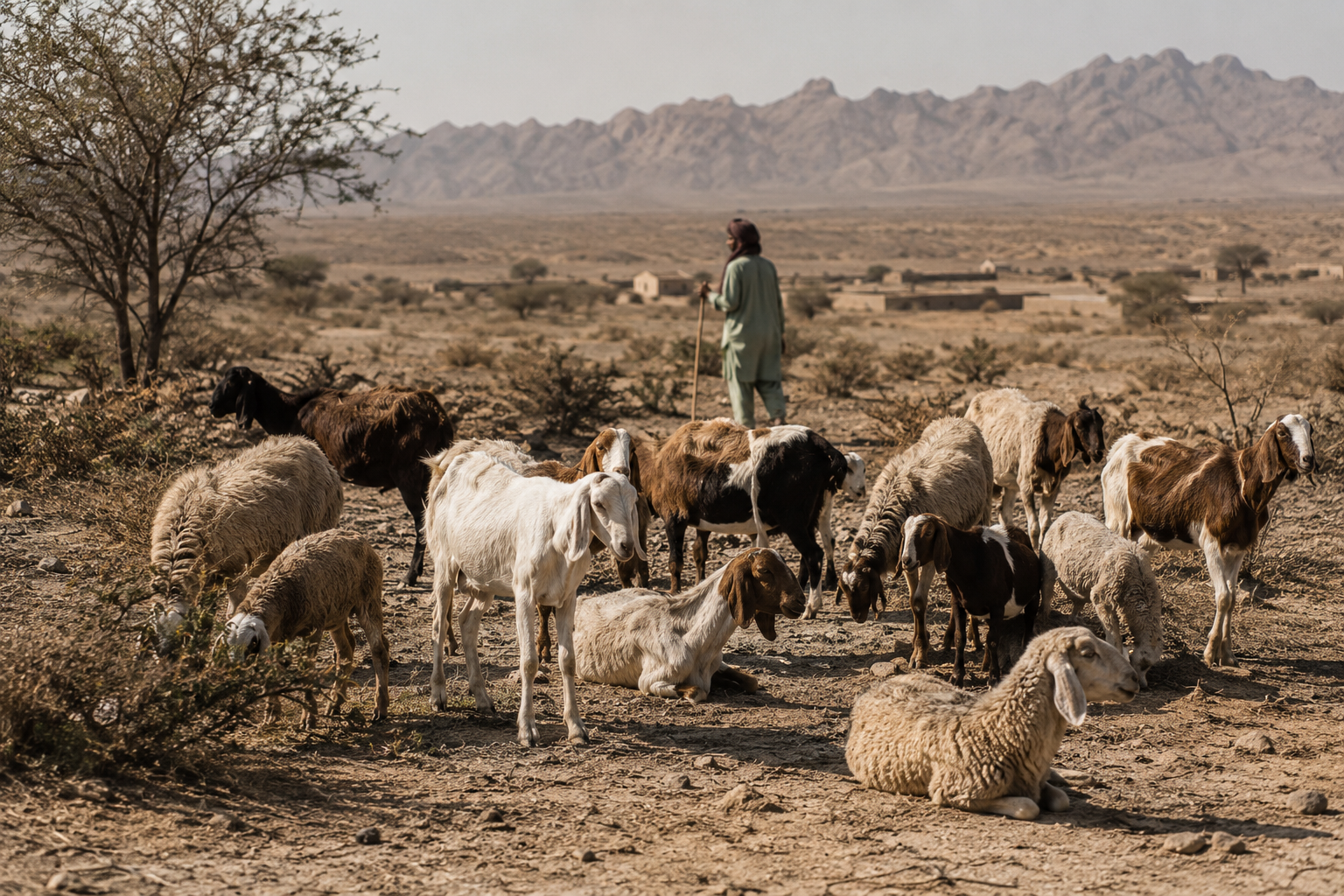
In many rural parts of Pakistan, people do not first learn about climate change from reports, forecasts, or official warnings. They learn it from animals.
A goat that stops gaining weight. A cow that produces less milk. Sheep that fall sick earlier than usual. A herd that refuses to travel long distances. For pastoral and farming families in Balochistan, Sindh, and southern Khyber Pakhtunkhwa, these changes are becoming more common, and they are no longer treated as isolated problems. They are seen as signals that something in the environment is shifting.
In Tharparkar, where livelihoods depend heavily on rain and grazing land, livestock owners say the rhythm of animal life has changed. Rain no longer guarantees grass. Even when it comes, it is often followed by long dry spells that erase the short relief it brings.
A livestock owner in Islamkot says he has started adjusting his decisions earlier than before. He no longer waits for visible drought conditions. He watches his animals instead. “If they are weak, we know the season will be hard,” he says. Over the last few years, he has reduced his herd size, not by choice but by necessity.
Similar accounts come from Balochistan’s pastoral belts, where communities have long depended on seasonal movement. In areas like Khuzdar and Kachhi, herders describe a growing uncertainty in grazing routes. A herder explains that movement now happens earlier in the season. Waiting longer means animals lose strength before reaching the next grazing point.
These shifts are not happening in isolation. Pakistan’s livestock population remains one of the largest in the region and contributes significantly to rural livelihoods. Yet provincial livestock departments have been reporting increasing pressure on animal health, especially during heatwaves and dry periods.
Officials point to rising cases of disease, heat stress, and fodder shortages. In many districts, veterinary teams say animals are arriving for treatment too late, when recovery is already difficult. The problem is not only disease but also the weakening of natural grazing systems.
In southern Khyber Pakhtunkhwa, farmers describe another layer of change. Livestock productivity is declining during hotter months. Milk yields drop, animals eat less, and they spend more time standing in shade. A farmer in Tank says even short heat spells now affect his cattle. “It is not one big disaster. It is small changes every season,” he says.
This idea of “small changes” is repeated across regions. Climate change is not always visible as a single event. It appears through gradual shifts in animal behavior and survival patterns. For many rural families, livestock becomes the first system where these shifts are noticed.
Experts working on rural climate adaptation say livestock is often more sensitive to environmental stress than crops. Animals respond quickly to changes in temperature, water availability, and pasture quality. This makes them an early indicator of climate pressure in agrarian economies like Pakistan.
But while animals reflect change early, the response systems are slower. Veterinary services in remote districts are limited. Fodder prices rise sharply during drought periods. Transporting animals to safer areas is expensive. As a result, families often sell livestock at lower prices just to manage immediate needs.
In Sindh’s Dadu district, where floods have repeatedly disrupted life in recent years, livestock losses remain a major concern. Farmers describe a cycle that repeats itself. Floods destroy feed stocks and grazing land. After water recedes, diseases spread among weakened animals. Recovery takes months, sometimes years.
A farmer in Dadu says rebuilding a house is easier than rebuilding a herd. “Walls can be fixed. Animals take time. Some never return,” he says.
In Balochistan, pastoral mobility has historically been a survival strategy. Communities move between seasonal grazing zones depending on rainfall and temperature. But that system is under pressure. Traditional knowledge about timing and routes is becoming less reliable as climate patterns shift.
A herder from Kharan says the uncertainty is new. “Earlier we knew when to move. Now we guess,” he says. That uncertainty carries risk. Moving too early means losing access to better grazing. Moving too late means losing animals on the journey.
Livestock is also deeply tied to household economics. In many rural families, animals represent savings, income, and security at the same time. When climate stress increases, selling livestock becomes one of the first coping strategies. But this also reduces long-term stability.
Veterinary workers in rural clinics report rising cases of heat-related stress in animals. Dehydration, reduced fertility, and digestive issues are becoming more frequent during extreme weather periods. Many of these cases are linked to poor fodder quality and limited access to clean water.
Despite these pressures, livestock remains central to rural life. It is still one of the main sources of income in many districts, and in some areas, it is the only reliable asset families own. This makes climate impacts on livestock more than an agricultural issue. It becomes a livelihood issue.
Government departments acknowledge the growing challenge. Officials say adaptation efforts are being discussed, including mobile veterinary units, fodder support programs, and improved early warning systems. But implementation remains uneven, especially in remote and under-resourced regions.
One official notes that climate variability has changed the nature of livestock management. It is no longer just about breeding and disease control. It is about coping with uncertainty in weather and resources.
For rural communities, however, these changes are already part of daily life. They do not need scientific confirmation to know that conditions are shifting. They see it in the behavior of their animals.
When livestock begins to struggle, it often means the environment has already changed. By the time official systems respond, families have usually already made decisions—selling animals, moving temporarily, or reducing herd sizes.
In this way, livestock is not just an economic asset in Pakistan’s rural areas. It is also a warning system. One that is read not in data charts, but in the quiet changes of everyday life in fields, deserts, and riverine belts.
