


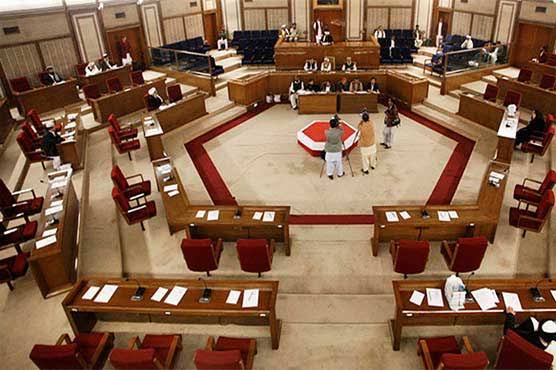
The Balochistan Assembly has passed an amendment bill related to anti-terrorism and forensic science. The bill was presented in the Assembly on Wednesday by Parliamentary Secretary Zareen Khan Magsi.
During the session, Provincial Assembly member Maulana Hidayat-ur-Rehman Baloch opposed the bill, arguing that its approval would turn justice into a “WhatsApp process,” where the affected parties would not even know about the witnesses.
He warned that if an innocent person is killed under this law, the government would be held responsible. He stressed that instead of introducing such laws, reforms should be made in the judicial system.
Chief Minister Balochistan Mir Sarfraz Ahmed Bugti, addressing the House, acknowledged that such decisions may not be popular at the public level, but emphasized that special laws are essential to tackle the grave challenge of terrorism.
He clarified that the law is not meant against political workers but is designed to provide protection to judges and witnesses. Recalling a past incident where passengers were taken off a bus and killed, he pointed out that no one was willing to testify due to fear.
The Chief Minister further stated that some political parties only use the issue of missing persons as a political tool but fail to present any practical solutions. He asserted that through special legislation, efforts would be made to resolve the missing persons issue because the state belongs to all and cannot be allowed to weaken.
The law introduces a new section, 21AAA, into the Anti-Terrorism Act 1997, titled “Special Provisions Relating to Certain Trials.” This section will have an overriding effect over all other laws in force.The provincial government will establish an authority headed by a Grade-21 officer or equivalent, who, in consultation with the Chief Justice of the Balochistan High Court, will select cases requiring extraordinary protective measures.
The authority will assign such cases to designated judges and coordinate with the Government of Balochistan. The officer’s identity, appointment, and credentials will remain confidential, shared only with the Chief Justice of the Balochistan High Court.If extraordinary protection is required for judges, lawyers, or witnesses, the Chief Justice of the Balochistan High Court will constitute a panel of three judges, from which the authority will nominate one to hear the case. Similarly, a panel of five government prosecutors will be formed, and one will be selected to pursue the case.
The real identities of judges, lawyers, and witnesses will remain confidential, and only official designations or symbolic identifiers will be recorded. Witnesses will be given special codes, and even court orders will carry symbolic identities.
This record will be preserved only with the Chief Justice and the authority.Proceedings of specific cases may be conducted via video conferencing and audio/video recording. Voice-distortion technology will be used to conceal identities.
Hearings will take place only in secure enclosures, with access limited to relevant individuals. If required, proceedings may also be held virtually from jails or other secure locations.
The new law will also apply to appeals and all related judicial proceedings to ensure complete confidentiality and protection of all parties involved.With its approval, the new legislation will reshape how anti-terrorism trials are conducted in Balochistan, aiming to balance the imperatives of security with the demands of justice.
