


New York: If the world stays on its current path, more than 351 million women and girls will still be living in extreme poverty by 2030, a staggering figure that exposes how far we are from meeting global promises on gender equality. This sobering warning comes from the newly launched Gender Snapshot 2025, produced by UN Women and the UN Department of Economic and Social Affairs (UN DESA).
The report doesn’t mince words: the failure to deliver on gender equality is not inevitable. It would be the result of political choices, systemic neglect, stalled investments, and a retreat from equality. Yet, the data also offers a way forward. Closing the gender digital divide alone could lift 30 million women and girls out of poverty and add USD 1.5 trillion to the global economy by 2030.
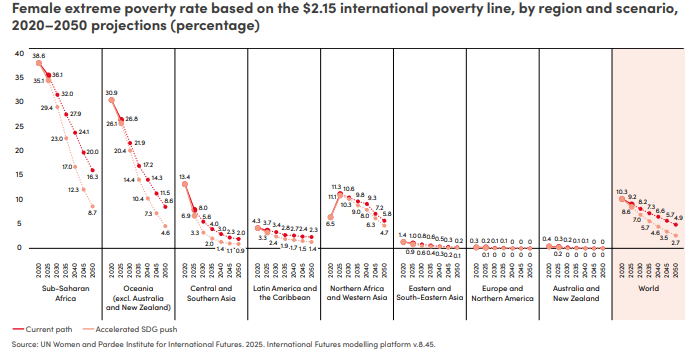
Female extreme poverty has barely shifted in recent years, hovering around 10% since 2020. If trends continue, 8.2% of women and girls will remain in extreme poverty by 2030. By contrast, accelerating SDG implementation could cut female extreme poverty from 9.2% in 2025 to just 2.7% by 2050.
This is not just about numbers, it’s about women unable to afford food for their children, girls dropping out of school to support families, and communities losing potential leaders to cycles of deprivation.
From 2000 to 2023, maternal mortality declined by nearly 40%, a major achievement. But women’s health is still undermined in quieter ways. In 2021, women spent an average of 10.9 years of their lives in poor health, compared to 8 years for men. Chronic conditions, untreated illnesses, and limited access to care weigh heavily on them.
Nutrition deepens this crisis. Nearly 64 million more women than men are food insecure. Anaemia is expected to rise among women aged 15–49 from 31.1% in 2025 to 33% in 2030, worsening health outcomes for millions.
In the past five years, 99 legal reforms worldwide have chipped away at discriminatory laws. But many gaps remain. Only 38 countries have set the minimum marriage age at 18 without exceptions, and just 63 have rape laws based on lack of consent.
The consequences are stark. One in eight women aged 15–49 has been subjected to physical or sexual violence by an intimate partner in the past year. Nearly one in five young women aged 20–24 was married before turning 18. Each year, four million girls undergo female genital mutilation, more than two million before the age of five.
Women’s presence in power is growing, but slowly. As of January 2025, they held 27.2% of seats in national parliaments, an increase, but far from parity. Local government representation has stalled at 35.5%, and women hold just 30% of managerial roles. At the current pace, gender parity in management will take nearly a century. Though, 102 countries have never had a woman head of state or government.
Just over half (56.3%) of women in unions or marriages report full decision-making power over their sexual and reproductive health and rights. For many, the most intimate choices remain out of their hands.
Technology tells a similar story. While the gender gap in mobile phone ownership narrowed from 9.4% to 7% between 2021 and 2024, digital exclusion continues to lock millions of women out of opportunities for education, work, and civic participation.
Girls have overtaken boys globally in enrolment and completion of schooling. But in regions like sub-Saharan Africa and Central and Southern Asia, girls still trail in secondary completion. Leadership roles are also elusive, while women dominate classrooms as teachers, they are far less likely to become principals. In 65 of 70 countries, women are more likely to teach than lead schools, with an average leadership gap of 20 percentage points.
Conflict makes inequalities sharper. In 2024, 676 million women and girls lived within 50 kilometres of a deadly conflict event, the highest level since the 1990s. While national action plans on Women, Peace, and Security now exist in 113 countries, funding and enforcement remain uncertain.
At home, the unpaid care burden remains one of the most stubborn barriers to equality. Globally, women spend 2.5 times as many hours as men on unpaid domestic and care work. In Northern Africa and Western Asia, the gap rises to four times as many hours.
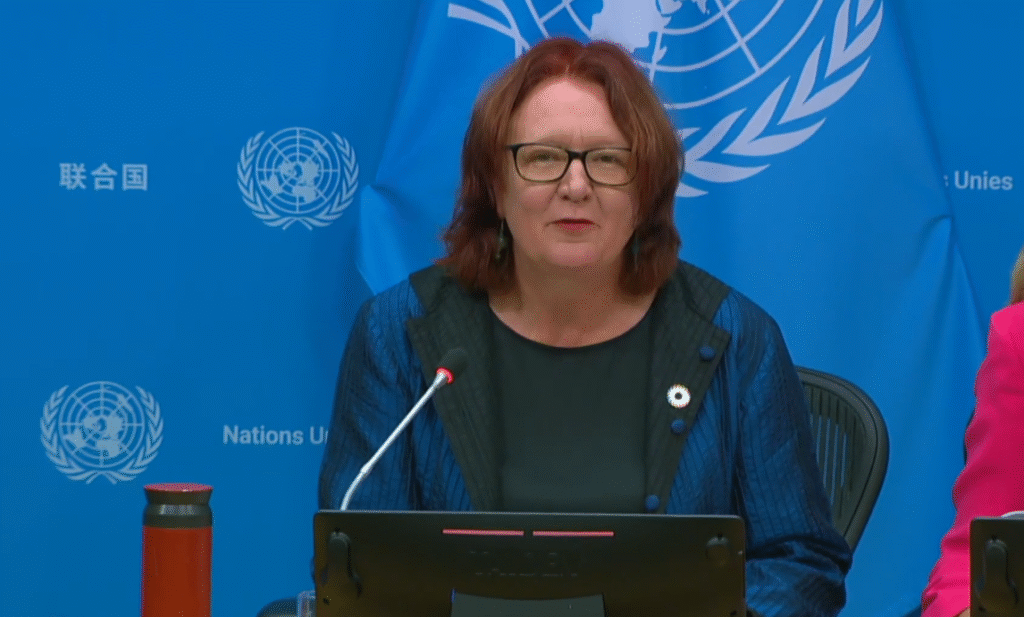
At the launch, UN Women’s Sarah Hendriks said, “Gender equality is not an ideology, it is foundational to peace, development, and human rights.”
The Gender Snapshot 2025 warns that without urgent action, the world will miss not only SDG 5 on gender equality but also the wider 2030 Agenda. The report points to solutions, stressing that investment in digital access and poverty reduction could improve millions of lives.
