


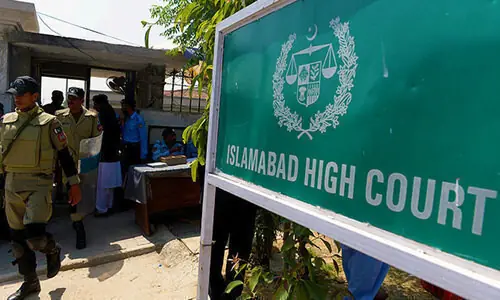
Islamabad, March 28: The Islamabad High Court (IHC) has issued a landmark judgment declaring the government’s “double supersession” rule—under which civil servants were permanently disqualified from promotion to Grade 22 after being superseded twice—illegal and unconstitutional.
The 63-page detailed verdict, authored by Justice Raja Inam Ameen Minhas, is being hailed as a major step toward transparency and fairness in Pakistan’s bureaucratic promotion system.
controversial promotion rule declared void
The court ruled that the double supersession policy had no legal basis, reaffirming that promotion is a fundamental right for all eligible officers. The judgment stated that promotion decisions must be based strictly on merit, performance, and official service records, not on arbitrary interpretations or informal assessments.
seven senior officers’ cases to be reconsidered
In its order, the IHC partially set aside the recommendations of the High Powered Selection Board’s 29th meeting. Authorities have been directed to reconsider the cases of seven senior civil servants, including Muhammad Asad Islam Madni, Murtaza Khan, and Sohail Ali Khan.
appointment of senior police officer as osd declared illegal
In a separate ruling, the court held that the designation of senior police officer M. Aamir Zulfiqar Khan as Officer on Special Duty (OSD) was unlawful. The federal government has been directed to assign him an appropriate post within 30 days.
strict principles issued for promotion decisions
The judgment outlined several mandatory guidelines for all future promotion assessments:
Officers cannot be denied promotion on the basis of personal opinions, unverified assumptions, or rumors.
Allegations regarding integrity must be supported by credible, documented evidence.
Written reasons must be provided within 14 days if an officer is denied promotion.
political observers’ participation upheld
The court ruled that the presence of Bilawal Bhutto Zardari and Khawaja Asif as observers in the selection board meeting was lawful. It also declared that Deputy Prime Minister Ishaq Dar’s role as chairperson of the meeting was valid under the law.
misuse of ‘classified’ status strongly criticized
The verdict criticized the arbitrary classification of official records, stating:
No document can be marked classified without written justification.
Authorities must prove that withholding information serves the public interest more than disclosure.
The IHC ruled that the previous Prime Minister’s decision to mark certain records as classified, without providing reasons, was unlawful.
emphasis on transparency and fair trial rights
The court held that denying officers access to the materials used to decide their promotions violates transparency and principles of fair trial. Confidentiality, it noted, cannot be used to conceal irrelevant or unverified information.
“Officers must be given enough information to understand why they were denied promotion and be able to challenge the decision effectively,” the verdict stated.
The ruling is widely viewed as a significant reform measure aimed at ensuring merit-based promotions, limiting arbitrary powers, and strengthening transparency within Pakistan’s bureaucratic governance system.
