


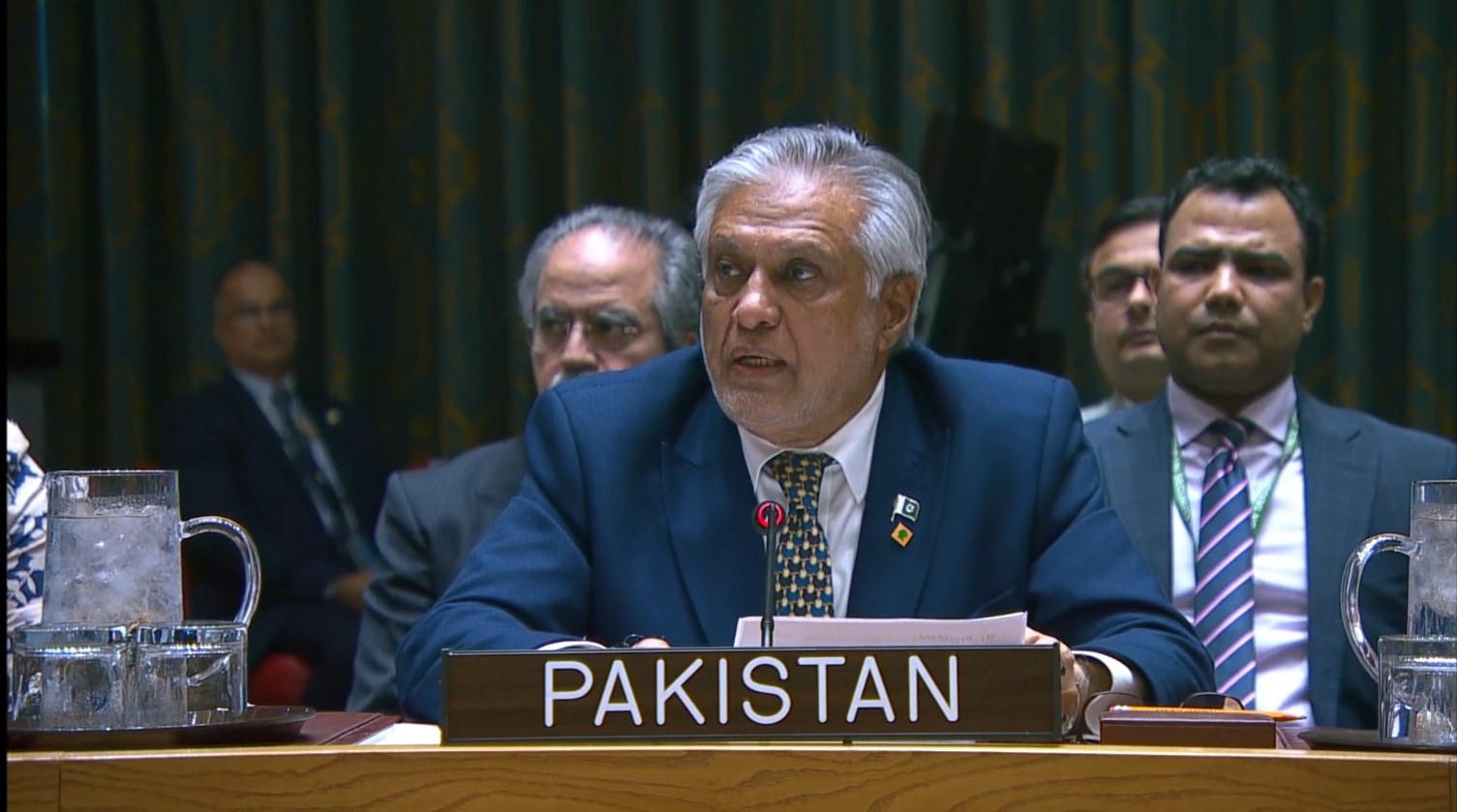
New York: Pakistan’s Deputy Prime Minister and Foreign Minister, Senator Mohammad Ishaq Dar, delivered a powerful address at the United Nations Security Council today, urging urgent action to address the ongoing humanitarian crisis in Palestine and the wider Middle East. In his speech, Senator Dar expressed deep concern over the scale of suffering endured by the Palestinian people, highlighting the destruction of hospitals, schools, markets, roads, and utilities, and describing how the very fabric of society has collapsed. He noted that over 64,000 lives have been lost and more than 100,000 people have been injured, emphasizing that these were grieving mothers, anguished fathers, suffering children, and veterans caught in the devastation.
The Foreign Minister also drew attention to the humanitarian catastrophe unfolding in Baghdad, warning of famine and mass displacement. He stated that 300,000 people have already been uprooted and nearly one million face imminent displacement, condemning the ongoing violence that disproportionately affects women, children, and the most vulnerable populations. He stressed that the world must not remain silent and that the international community has a moral obligation to intervene.
Senator Dar called for immediate and decisive measures, including a permanent ceasefire to halt bloodshed, unhindered humanitarian access to Gaza, and protection of Palestinians’ right of return through the establishment of international safeguards. He reaffirmed Pakistan’s long-standing support for the Palestinian people and their right to a sovereign and independent state within the pre-1967 borders, with al-Qusayr al-Sharif as its capital. He welcomed the European Solution Conference hosted by France and Saudi Arabia and praised Member States that have recognized the State of Palestine.
“Gaza has become a graveyard for humanity as well as for the global conscience,” he said, urging the Security Council and the broader international community to act decisively to uphold human dignity, ensure accountability, and deliver justice. He concluded by commending the Secretary-General’s efforts and emphasized that the time for words has passed and that the time for action is now.
